403 498 8884

403 498 8884
Unlock the Secrets to a Happier, Healthier You
Discover Our Latest Blog Posts!

The 3-Part Check-In That Keeps Stress From Building Up
Stress rarely announces itself with a dramatic moment. More often, it accumulates quietly — one small pressure stacking on top of another until the weight feels overwhelming. By the time most people notice, they're already running on empty.
The good news? You don't need an hour of meditation or a weekend retreat to stay ahead of it. A simple, structured check-in — taking five minutes or less — can interrupt the buildup before it peaks. This post introduces a practical three-part model covering your mind, emotions, and body, and shows you exactly how to use it, when to use it, and how to make it work even on your busiest days.
Why Stress Builds Up Without Warning
Most people think of stress as something they'll feel when it arrives. In reality, stress accumulates in layers — and each layer tends to be small enough to ignore in the moment.
A tense meeting. A forgotten task. A difficult phone call. A skipped lunch. None of these feel catastrophic on their own. But they pile up through the day, and the nervous system keeps a running total even when your conscious mind isn't paying attention.
By mid-afternoon, you might feel inexplicably irritable. By evening, you're exhausted but can't wind down. By the weekend, you wonder why you need two days just to feel like yourself again.
This is the cost of unnoticed accumulation. And it's preventable — not by eliminating stress, but by catching it earlier.
The Problem With "Pushing Through"
The default response to stress for most people is to push through it. Keep moving, stay productive, deal with feelings later. This strategy works short-term but compounds the problem over time.
When stress signals go unacknowledged, the nervous system doesn't reset. Tension that could have been released in five minutes gets carried forward into the next hour, the next day, the next week. What begins as mild pressure becomes chronic fatigue, anxiety, or burnout.
The check-in practice described here works precisely because it interrupts that carry-forward effect. It gives your system a chance to process, release, and recalibrate before the load becomes unmanageable.
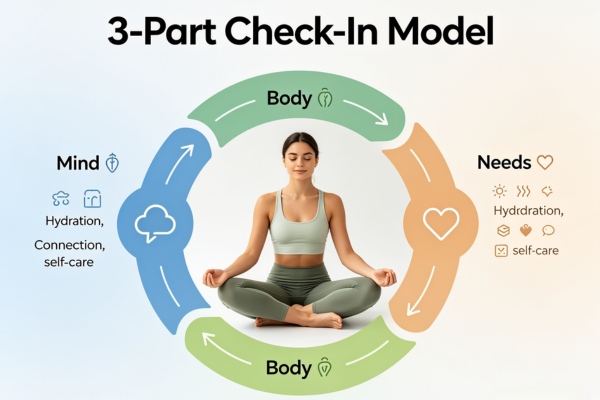
Introducing the 3-Part Check-In Model
The check-in covers three dimensions of your experience: mental, emotional, and physical. These aren't separate categories — they influence each other constantly. But addressing each one briefly and intentionally ensures nothing important gets overlooked.
Think of it as a quick internal audit. You're not trying to solve anything in the moment. You're simply noticing where you are so you can respond with intention rather than react from overload.
Part 1 — The Mental Check-In
What's occupying your mind right now?
The mental layer is about the content of your thoughts — what you're focused on, what's looping, what feels unresolved.
Ask yourself these questions:
Is my mind racing or relatively clear?
What's taking up the most mental space right now?
Am I catastrophizing, ruminating, or stuck in planning mode?
You're not trying to fix anything here. You're noticing. Awareness is the first intervention.
If your mind is crowded, try a brief "brain dump" — spend 60 seconds writing down every thought competing for your attention. This simple act moves content from active working memory onto the page, reducing cognitive load immediately.
Example: Imagine someone named Tom, a project manager juggling three deadlines. During a mid-morning check-in, he notices his mind keeps circling back to an email he hasn't responded to yet. He hasn't written the response — he's just been quietly dreading it for two hours. Naming that, he decides to handle the email right after his check-in. The mental loop closes. He can focus again.

Part 2 — The Emotional Check-In
What are you actually feeling right now?
This is the step most people skip — partly because it feels unfamiliar, and partly because the honest answer sometimes surprises us.
Ask yourself:
What emotion is most present for me right now?
Is there something I've been feeling but haven't let myself acknowledge?
Am I carrying tension from an earlier conversation or situation?
You don't need to analyze the emotion or explain it away. Just name it.
Research consistently shows that naming an emotion — even internally — reduces its intensity. The act of labeling what you feel moves processing from the reactive part of the brain to the reflective part. That shift, on its own, creates relief.
If you find it hard to identify emotions, try using a simple spectrum rather than precise labels. Ask: Am I feeling settled or unsettled? Heavy or light? Open or closed? These broader descriptors are easier to access under stress and still give you useful information.
Common emotions that hide under "stressed" or "fine":
Low-level anxiety about something unresolved
Quiet frustration at a repeated pattern
Sadness or disappointment you haven't had space to feel
Relief you haven't fully allowed yourself
Naming any of these honestly is the beginning of processing them.
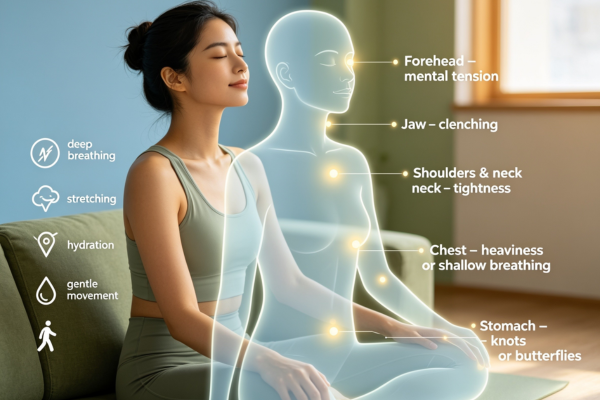
Part 3 — The Physical Check-In
What is your body telling you right now?
Your body holds stress in specific ways, and it often communicates before your mind catches up. This part of the check-in brings your physical experience into awareness.
Run through these briefly:
Where am I holding tension? (shoulders, jaw, chest, gut)
How is my breathing right now — shallow or full?
When did I last eat, drink water, or stretch?
Do I feel physically energized, fatigued, or somewhere in between?
You're looking for signals, not diagnoses. Common physical patterns linked to accumulated stress include raised shoulders, a tightened jaw, a constricted chest, or a low-grade headache that crept in unnoticed.
Once you've noticed, do something small and immediate. Drop your shoulders. Take three slow, deliberate breaths. Drink a glass of water. Stand up and stretch for thirty seconds. These micro-responses don't require time — they require only awareness and a moment of intention.
Small physical releases prevent tension from calcifying into something that requires more significant intervention later.
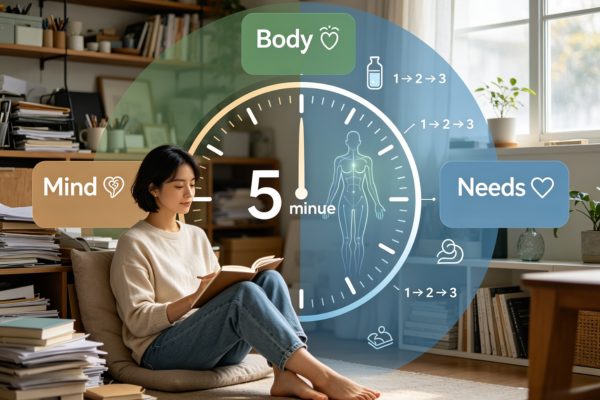
How to Do the Full Check-In in Five Minutes or Less
Here is the complete sequence laid out simply. You can adapt the timing based on your situation, but aim for this structure when you're starting out.
Minute 1 — Settle in
Close your eyes or soften your gaze. Take three slow breaths. Let your focus shift inward before you begin.
Minutes 2–3 — The Three Questions
Ask each check-in question and sit briefly with your honest answer:
What's occupying my mind right now?
What am I actually feeling?
What is my body telling me?
Don't rush. Give each question 20–30 seconds of genuine attention.
Minute 4 — A small response
Based on what you noticed, take one small action. Write a brain-dump sentence or two. Name an emotion and breathe through it. Roll your shoulders back. Drink some water. One action that acknowledges what you found.
Minute 5 — Reset and intention
Take one final slow breath. Ask: What's the one most important thing I want to focus on next? This forward-facing question closes the check-in and sets a direction — without adding pressure.
That's it. Five minutes, three layers, one small response. Done consistently, this practice changes how stress accumulates in your system over time.
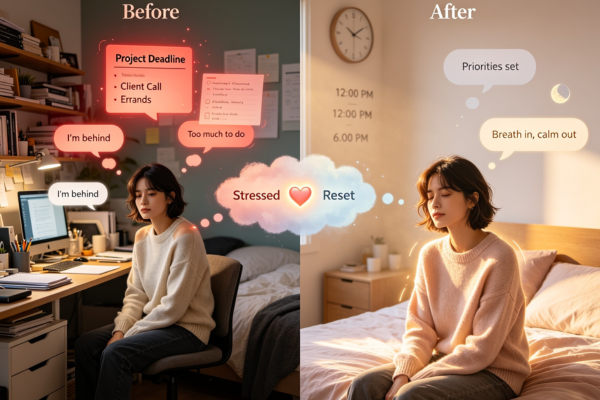
Using It as a Midday Reset or End-of-Day Debrief
The three-part check-in is versatile. Two specific applications tend to produce the most noticeable benefit.
The Midday Reset
The middle of the day — around noon or early afternoon — is when accumulated morning stress tends to peak. Decisions have been made, emails have landed, conversations have carried emotional weight. Without a reset, that load often gets carried straight through the afternoon, compounding further.
A midday check-in acts as a pressure valve. It gives you a brief but genuine pause to process what's already happened before it carries forward. Even doing it during a lunch break, while sitting quietly for five minutes away from screens, produces a measurable shift in focus and mood for many people.
If a midday pause feels impossible, try pairing the check-in with something you already do — making coffee, washing your hands, or sitting in your car before re-entering the building.
The End-of-Day Debrief
Stress that doesn't get acknowledged during the day tends to follow you home. The end-of-day debrief version of the check-in is designed to create a psychological boundary between work or responsibilities and personal time.
Before you transition — whether that means leaving the office, closing your laptop, or shifting from work mode to family mode — spend five minutes running through the three parts. The goal isn't to solve anything. It's to acknowledge what happened, name what you're carrying, release what you can, and step across the threshold consciously.
Many people find that doing this even informally — sitting in the car for five minutes before going inside — significantly improves their evenings. They arrive more present, less reactive, and better able to enjoy what the rest of the day has to offer.
Making It Work for Busy Schedules and Different Lifestyles
The most common reason people abandon wellbeing practices is that they feel like one more thing to add to an already full life. The three-part check-in is designed to counter that.
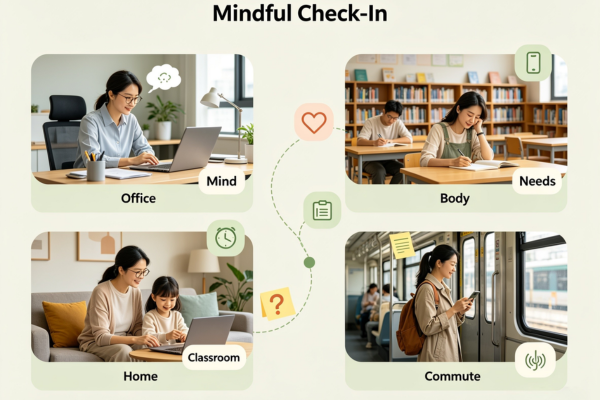
For very busy people: Compress all three questions into 90 seconds. Ask them in your head during a commute, while waiting for a meeting to start, or on a brief walk to the printer. The practice doesn't require perfect conditions — it requires consistent intention.
For parents or caregivers: Build the check-in into transition moments that already exist — school pick-up, naptime, bedtime routines. These natural pauses are underused opportunities to reset without adding new schedule demands.
For shift workers or irregular schedules: Anchor the check-in to a physical ritual rather than a time of day. Every time you make tea or coffee, every time you change locations, perform a brief version. The trigger is the action, not the clock.
For those who resist sitting still: Do it while moving. A five-minute walk can hold the check-in easily. Many people find that gentle movement actually makes the emotional and physical layers easier to access.
For skeptics: Try it once a day for one week without judgment. You're not committing to a lifestyle change — you're running an experiment. What you notice in those seven days is your data.
A Small Practice With a Lasting Impact
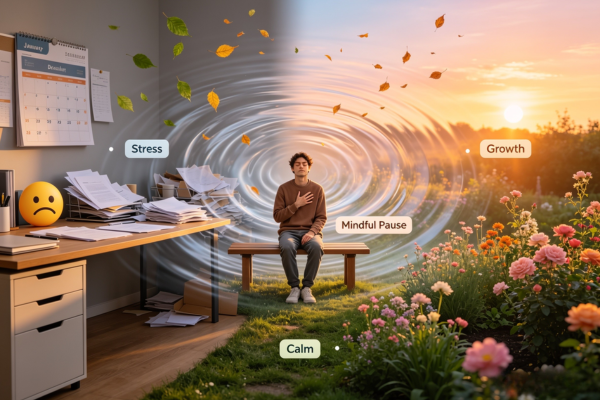
Stress doesn't build up overnight, and it doesn't disappear overnight either. But the people who manage it most effectively aren't usually the ones who experience less of it — they're the ones who check in more often.
The three-part check-in is not a cure for all stress. It's a habit of noticing — a consistent, gentle act of self-awareness that keeps small pressures from becoming large ones. Over time, it reshapes your baseline. Your nervous system spends more time in a regulated state, your emotional responses become more measured, and your ability to handle difficulty improves not because life got easier, but because you started paying closer attention to yourself.
Start today. Set a single reminder for noon or the end of your workday. When it goes off, ask three questions, take one small action, and set one intention. That's the whole thing. Do it tomorrow too. Then the next day.
The habit you build this week may be one of the most quietly powerful investments you make in your mental health all year.


Download Your Free Everyone's Guide to Serene Hypnosis
Your Free Download Is Ready To Be Sent!
Please Remember:
As with any Therapy, actual results may vary based on individual results. This is not a substitute for medical advice or treatment. Please do not stop, alter or modify any medications without consulting your prescribing doctor or medical professional first.
CONTACT US
Serene Hypnotherapy Health & Wellness
Paramount Learning Systems Inc.
Varsity Medical Professional Building
8 Varsity Estates Circle NW
3rd Floor Calgary, Alberta
Canada. T3A 2Z3
403-498-8884
Membership Association

All Rights Reserved 2015 - 2026 Powered by Serene Health & Wellness
All Rights Reserved 2015 - 2026
Powered by Serene Health & Wellness
Privacy Policy | Terms and Conditions