403 498 8884

403 498 8884
Unlock the Secrets to a Happier, Healthier You
Discover Our Latest Blog Posts!

When Anxiety Feels Like Intuition: How to Tell the Difference
You're about to make a decision — a new job, ending a relationship, moving to a new city — and suddenly your gut speaks up. Your chest tightens. Your mind races. Something feels off.
But is that your intuition warning you away from a genuine mistake? Or is it anxiety keeping you small?
This is one of the most disorienting challenges in emotional self-awareness: anxiety and intuition can feel almost identical in the moment. Both arrive as strong internal signals. Both feel urgent. Both seem to be "telling you something." But acting on the wrong one can cost you — either by pulling you back from something good out of fear, or by ignoring a real warning you needed to hear.
Here's how to tell them apart — and how to make decisions from clarity rather than fear.

Why Anxiety and Intuition Feel So Similar
Both anxiety and intuition live in the body. That's part of why they're so easy to confuse. The racing heart, the uneasy stomach, the sense that something isn't right — these physical signals don't come with a label explaining whether they're protective wisdom or protective fear.
There's a reason for this. Anxiety and intuition share the same nervous system. They both draw from your accumulated experiences, your threat-detection instincts, and your emotional memory. The difference lies not in the channel, but in the message — and in what's driving it.
Intuition tends to draw from pattern recognition and lived experience. It's the quiet knowledge that something doesn't add up, even before you can explain why. Anxiety, on the other hand, often draws from fear of uncertainty, past pain, or a deeply held belief that things will go wrong.
One is reading the present situation clearly. The other is filtering it through a lens of what you're afraid might happen.
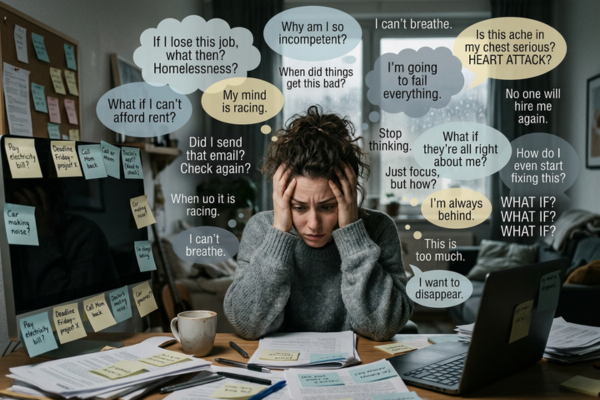
What Anxiety Usually Sounds Like
Anxiety has a few signature qualities that distinguish it from intuition, once you know what to look for.
It's loud and repetitive. Anxiety tends to loop. You find yourself thinking the same worried thought over and over, often with increasing intensity. It doesn't land and settle — it spirals.
It focuses on worst-case scenarios. The anxious mind is a skilled catastrophizer. It jumps to the most threatening outcome, skips over nuance, and tends to predict disaster regardless of how likely it actually is.
It's attached to what others might think. A lot of anxious signals are rooted in social fear — what will people say, how will I be judged, what if I fail publicly. These concerns are real and valid, but they're not the same as genuine intuitive warnings.
It grows when you sit with uncertainty. The more ambiguous a situation, the louder anxiety tends to get. It hates not knowing. And that discomfort can masquerade as a signal that something is wrong, when really it's just discomfort with not having control.
It asks "what if" constantly. What if it doesn't work? What if I regret it? What if I'm wrong? These are anxiety's favorite questions.

What Intuition Usually Sounds Like
Intuition tends to have a different quality entirely — though it can take practice to recognize it beneath anxiety's noise.
It's quiet and steady. Genuine intuitive signals often arrive as a calm, clear knowing rather than a panicked alarm. They don't shout. They persist.
It's specific. Intuition often points at something concrete: a specific behavior you noticed, a particular detail that felt off, a consistent pattern over time. It's less "everything is terrible" and more "this particular thing doesn't feel right."
It doesn't need external validation. When something is genuinely off, you tend to know it even before you tell anyone. Anxiety, by contrast, often escalates when others seem unconcerned — because it craves reassurance and doesn't find relief in it.
It stays consistent. Intuition tends to hold steady over time, even as your emotional state shifts. Anxiety fluctuates — it might scream at you one hour and be completely quiet the next.
It can coexist with positive feelings. You can feel excited and still have a quiet sense that something specific is wrong. That coexistence is often a sign of intuition rather than anxiety, which tends to color the whole experience negatively.

A Simple Practice: The Body Check-In
Because both signals live in the body, one useful technique is learning to read your body more precisely — not just "does this feel bad" but where and how.
Try this: When a strong internal signal arrives, pause and ask yourself a few questions.
Where in my body do I feel this? Anxiety often shows up in the chest, throat, or upper body. Intuition tends to register lower — in the gut or solar plexus.
What happens if I sit with this feeling for 60 seconds without acting on it? Anxiety tends to intensify under pressure or silence. Intuition tends to deepen into clarity.
Has this feeling shown up consistently, or did it spike suddenly? Sudden spikes often indicate anxiety. A low, steady signal that keeps returning suggests something worth paying attention to.
This check-in won't give you a definitive answer every time. But it starts to teach you the difference between your body reacting to fear and your body recognizing truth.

When Fear Has a Point
Here's something worth naming: anxiety isn't always wrong. Sometimes what feels like catastrophizing is actually a reasonable read of a genuinely difficult situation. The goal isn't to dismiss anxious signals entirely — it's to evaluate them rather than automatically following or fighting them.
Ask yourself: Is there actual evidence for what I'm worried about, or am I generating the threat from imagination? If you can point to specific, observable things that concern you, that's worth taking seriously regardless of whether it's "intuition" or "anxiety." The distinction matters most when the signals are vague and generalized — when anxiety is pulling you back from something good based on fear alone.

Common Situations Where This Gets Confusing
New opportunities. That nervous excitement before something big is almost always anxiety, not a warning. Newness triggers threat responses even when there's no actual threat. The question isn't whether you feel scared — it's whether the fear is pointing at something real.
Relationships. This one is particularly tricky. Anxiety from past relationship wounds can feel like intuition about a current partner. Getting clarity here often means asking: Am I responding to what this person is actually doing, or to what someone else once did?
Big life decisions. Uncertainty alone is not a sign. Making a hard choice will almost always produce anxiety. The absence of anxiety is not a requirement for a good decision.

Making Decisions From a Clearer Place
You don't always need to know whether a signal is anxiety or intuition before you act. Sometimes the better move is to slow down enough to create space between the feeling and the decision.
A few approaches that help:
Write it out. Put the signal into words. Is it a story you're telling yourself, or an observation you've made? Writing often separates one from the other.
Give it time. If you can afford to wait, do. Anxious urgency often fades. Genuine intuitive signals tend to stay.
Talk to someone who knows you. Not for the validation — but to hear yourself say it out loud and notice what rings true.
Ask what you'd tell a friend. If someone you loved came to you with this exact situation, what would you tell them? Often we can access clearer thinking when we detach from the personal stakes.
The Takeaway
Anxiety and intuition both deserve to be heard — just not equally followed. The difference isn't always obvious at first, but with practice, you can learn to tell them apart. One is rooted in fear of what might happen. The other is rooted in a present, grounded recognition of what is.
Neither makes you weak. Neither makes you irrational. They're both part of how you process the world. The goal is simply to know which voice is speaking so you can decide how much weight to give it.
Start small. The next time a strong internal signal shows up, pause before reacting. Ask: Is this fear, or is this knowing? You don't have to answer perfectly. You just have to start asking.


Download Your Free Everyone's Guide to Serene Hypnosis
Your Free Download Is Ready To Be Sent!
Please Remember:
As with any Therapy, actual results may vary based on individual results. This is not a substitute for medical advice or treatment. Please do not stop, alter or modify any medications without consulting your prescribing doctor or medical professional first.
CONTACT US
Serene Hypnotherapy Health & Wellness
Paramount Learning Systems Inc.
Varsity Medical Professional Building
8 Varsity Estates Circle NW
3rd Floor Calgary, Alberta
Canada. T3A 2Z3
403-498-8884

All Rights Reserved 2015 - 2026 Powered by Serene Health & Wellness
All Rights Reserved 2015 - 2026
Powered by Serene Health & Wellness
Privacy Policy | Terms and Conditions