403 498 8884

403 498 8884
Unlock the Secrets to a Happier, Healthier You
Discover Our Latest Blog Posts!

How Your Inner Critic Keeps You Stuck (And How to Respond)
There's a voice most of us carry around all day. It notices when you hesitate before speaking up in a meeting. It replays that awkward conversation from three years ago at 2 a.m. It tells you that you're too much, not enough, or somehow both at once.
That's your inner critic — and if you've never stopped to really examine it, you might not even realize how much it's quietly running the show.

What Is the Inner Critic, Really?
The inner critic isn't some separate entity living in your head. It's a part of you — one that developed over time, often as a way to protect you. When you were younger, being self-critical may have helped you avoid punishment, fit in, or meet the expectations of people whose approval you needed. In that context, the critic had a job.
The problem is that most of us never outgrew the version of it we built as kids. So now it shows up in situations where it no longer helps — and sometimes actively holds us back.
It might sound like:
"Who do you think you are?"
"You always mess things up."
"Don't say that. People will think you're stupid."
"Everyone else has their life together except you."
These thoughts feel true because they're familiar. Familiarity and truth aren't the same thing — but the brain doesn't always make that distinction easily.

The Ways It Keeps You Stuck
The inner critic is sneaky. It doesn't always show up as loud, obvious self-attacks. Sometimes it whispers. And sometimes those whispers shape your behavior in ways you don't consciously notice.
It kills action before you start. You have an idea, a goal, something you want to try — and before you even take the first step, the critic is already listing every reason it won't work or every way you'll embarrass yourself. So you don't start at all.
It keeps you small in relationships. If the critic tells you that your needs are a burden, or that honest expression will push people away, you learn to edit yourself constantly. You stay on the surface, never quite letting people in.
It fuels perfectionism. When nothing you do ever feels like enough, you either overwork yourself trying to earn approval you can't seem to keep — or you give up because why bother if it'll never be good enough anyway?
It makes rest feel unsafe. Without external productivity to point to, the critic gets louder. So you stay busy. Constantly. Because busyness at least gives you something to hold up as proof of your worth.
It distorts feedback. One critical comment lands ten times harder than ten positive ones. Neutral remarks get read as disapproval. The critic filters everything through its own lens, and the lens isn't neutral.

Why Silencing It Doesn't Work
The instinct most people have is to try to shut the inner critic up — to argue with it, override it, or shame it into silence. That almost never works.
When you fight a thought directly, you end up spending enormous energy on a battle that only makes the thought more central in your mind. It's a bit like trying not to think about something. The harder you try, the more it shows up.
Silencing also doesn't work because the inner critic, remember, was trying to protect you. If you treat it like a threat to be eliminated, it tends to dig in harder. There's a reason it exists. Acknowledging that reason matters.

A Different Way to Respond
The goal isn't to destroy your inner critic. It's to change your relationship with it — so it stops driving the car.
1. Notice it without fusing with it.
The first step is awareness. When you catch a self-critical thought, try naming it: "There's the critic again." This small act creates distance. You're observing the thought rather than becoming it. It's the difference between "I'm a failure" and "I'm having the thought that I'm a failure." The content is the same, but the relationship to it is completely different.
2. Get curious about where it came from.
Instead of arguing with the critic, ask: "What is this protecting me from?" Often the answer reveals something important — a fear of rejection, a belief that you don't deserve good things, an old wound that never quite healed. Understanding the root doesn't mean agreeing with the critic. It means you can meet the underlying fear with something more useful than a fight.
3. Respond with compassion, not cheerleading.
Self-compassion isn't the same as toxic positivity. You don't have to tell yourself you're amazing to push back against the critic. Instead, try responding the way you'd respond to a friend in the same situation. If a person you loved came to you and said "I think I'm a complete failure," you wouldn't just agree — but you also wouldn't dismiss them. You'd offer perspective. You'd remind them of the fuller picture.
Try that with yourself.
4. Don't let it make your decisions.
You don't have to act on what the inner critic says. You can feel the fear it's generating and take action anyway. The goal isn't fearlessness — it's learning to move forward even when the critic is loud.
5. Take note of patterns.
Keeping a journal, even briefly, can help you spot when the critic tends to show up most. Is it when you're tired? Before something important? Around certain people? Patterns give you information. Information gives you choice.

When the Critic Gets Especially Loud
There are seasons when the inner critic is more intense — during transitions, after setbacks, in periods of uncertainty. That's normal. It doesn't mean something is wrong with you. It usually means something feels threatening, and the old protective part of you has been activated.
In those moments, the goal isn't to feel better immediately. It's to avoid making permanent decisions based on temporary noise. Give yourself a little more space. Lower the stakes where you can. And remember that a loud critic isn't the same as a truthful one.
If you notice that your inner critic feels overwhelming, constant, or tied to thoughts of harming yourself, please reach out to a mental health professional. There's support available, and you don't have to navigate that alone.
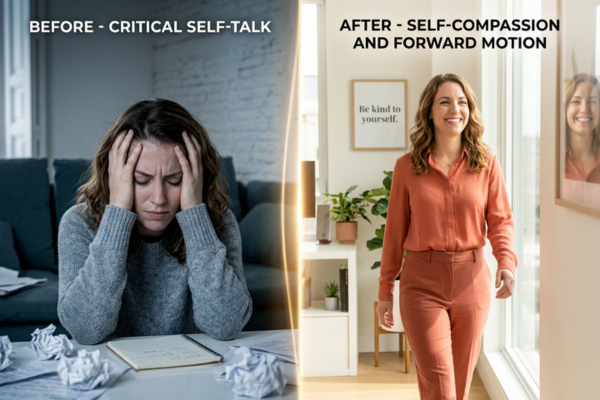
What Changes When You Start to Respond Differently
Over time, when you stop letting the critic have the final word, something shifts. It doesn't disappear — and honestly, it doesn't need to. But its grip loosens.
You start to notice more of what's actually going right. You make decisions from a clearer, more grounded place. You take up a little more space in conversations, in rooms, in your own life. You find it easier to be honest — with others and with yourself.
The inner critic was never your enemy. But it was never meant to be your guide either. There's a difference between a voice that offers a fair reality check and one that quietly convinced you that you weren't worth taking seriously.
You are. And learning to respond to yourself with that understanding might be one of the most important things you ever do.
If this resonated with you, take a moment today to notice when your inner critic shows up — and see if you can name it without following it. That's where it starts.
Meta Title: How Your Inner Critic Keeps You Stuck (And How to Respond)
Meta Description: Your inner critic isn't the enemy—but it can hold you back. Learn how to recognize its patterns and respond with self-compassion instead of silence or shame.


Download Your Free Everyone's Guide to Serene Hypnosis
Your Free Download Is Ready To Be Sent!
Please Remember:
As with any Therapy, actual results may vary based on individual results. This is not a substitute for medical advice or treatment. Please do not stop, alter or modify any medications without consulting your prescribing doctor or medical professional first.
CONTACT US
Serene Hypnotherapy Health & Wellness
Paramount Learning Systems Inc.
Varsity Medical Professional Building
8 Varsity Estates Circle NW
3rd Floor Calgary, Alberta
Canada. T3A 2Z3
403-498-8884
Membership Association

All Rights Reserved 2015 - 2026 Powered by Serene Health & Wellness
All Rights Reserved 2015 - 2026
Powered by Serene Health & Wellness
Privacy Policy | Terms and Conditions