403 498 8884

403 498 8884
Unlock the Secrets to a Happier, Healthier You
Discover Our Latest Blog Posts!
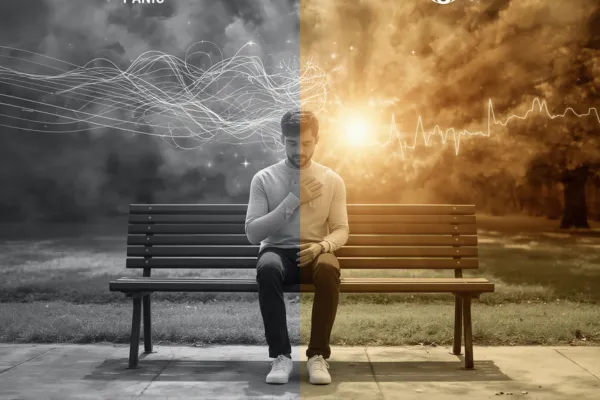
How to Stop a Panic Attack Before It Peaks
Panic attacks are one of the most frightening experiences a person can go through — not because they're dangerous, but because they feel that way. Your heart pounds, your chest tightens, your mind races toward worst-case scenarios, and your body seems to be sending every alarm it has at once. In those moments, it can feel like something is terribly wrong.
But here's what you need to know: panic attacks, while deeply uncomfortable, are not harmful. They peak and pass. And with the right tools, you can interrupt the cycle before it reaches full intensity — or at least move through it far more quickly than you might think possible.
In this post, you'll learn what's actually happening in your body during a panic attack, why the instinct to fight it tends to backfire, a step-by-step grounding sequence you can use anywhere, and how to build a personal panic response plan so you're never caught without a strategy.

What's Actually Happening During a Panic Attack
Understanding the mechanics of a panic attack doesn't make it comfortable, but it does make it less terrifying. And that distinction matters enormously.
When a panic attack begins, your nervous system has essentially triggered a false alarm. Your brain's threat-detection system — designed to protect you from genuine danger — fires as though something life-threatening is happening, even when it isn't. In response, your body does exactly what it's supposed to do in a crisis: it floods with adrenaline.
That surge of adrenaline drives every sensation you experience:
Racing heart — your body is pumping blood to your muscles, preparing for action
Shallow, rapid breathing — oxygen is being redirected to support a physical response
Dizziness or lightheadedness — a result of changes in carbon dioxide levels from fast breathing
Tingling in hands or feet — circulation is shifting toward the core
A feeling of unreality or detachment — your nervous system is in crisis mode, narrowing focus
An overwhelming urge to flee — the fight-or-flight response doing its job
None of these sensations are signs of collapse or catastrophe. They are signs of a body working exactly as it was designed to — just in response to a threat that isn't actually there.
Here's the critical point: a panic attack cannot harm you. It has a biological ceiling. The adrenaline surge peaks, typically within 5 to 10 minutes, and then your nervous system begins to recover. Every panic attack, no matter how intense, eventually passes on its own.
Knowing this doesn't switch off the fear response. But it creates a small but vital piece of psychological space — room for a different response than pure alarm.

Why Fighting the Sensation Makes It Worse
When a panic attack starts, the natural instinct is to resist it. You try to push the feelings away, convince yourself to stop, or demand that your body calm down immediately. This feels like the right strategy. It almost always backfires.
Here's why. When you fight a panic attack, you add a second layer of fear on top of the first. You're now afraid of the panic itself. That second layer activates the nervous system further — confirming to your brain that the situation is, in fact, dangerous. The alarm gets louder because you're responding to it as though it deserves to be louder.
This is sometimes called the fear-of-fear cycle, and it's what turns a single alarming moment into a sustained spiral.
Consider someone like Jenna, a 34-year-old teacher who experienced her first panic attack while standing in a grocery store checkout line. Nothing particularly stressful had happened. But out of nowhere, her heart started racing and she felt convinced something was seriously wrong with her. She gripped the cart and tried to suppress everything she was feeling. The harder she fought it, the worse it got. She left the store, sat in her car for twenty minutes, and drove home shaken.
The next week, she avoided the store entirely. Then she started avoiding other public spaces. The panic attacks, when they came, were getting longer — because her response to them was reinforcing the alarm system rather than deactivating it.
What Jenna eventually learned — and what you can learn now — is that the path through a panic attack is not resistance. It's redirection. Instead of fighting the wave, you learn to move with it while actively engaging your nervous system in a different direction.
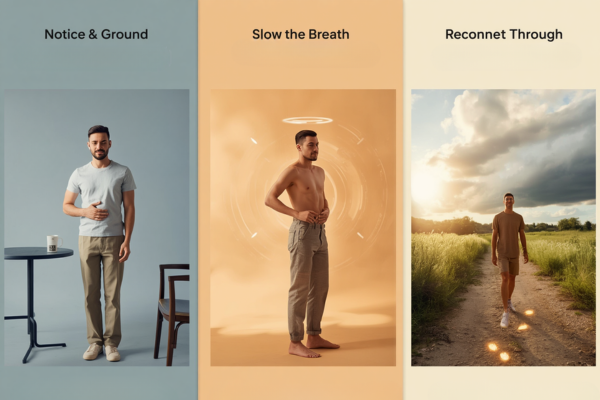
A Grounding Sequence to Use When Panic Begins
This sequence is designed for use at the earliest sign of a panic attack — the moment you notice your heart rate climbing, your breathing shifting, or that distinctive edge of alarm rising. The earlier you use it, the more effectively it works. But it can also help if you're already in the middle of a panic episode.
It works through three channels: senses, breath, and movement.
Step 1 — Ground Through Your Senses (The 5-4-3-2-1 Method)
Your senses are anchored in the present moment. When panic pulls you into a spiral of worst-case thinking, deliberately engaging your senses interrupts that spiral and redirects your brain's attention toward what is real and immediate.
Work through each sense in turn:
5 things you can see — name them quietly, in your head or aloud. A chair, a window, the pattern on the floor, a person walking past, the color of the wall.
4 things you can physically feel — your feet on the ground, the texture of your clothing, the temperature of the air, the weight of your hands in your lap.
3 things you can hear — traffic outside, a fan running, voices in the distance.
2 things you can smell — coffee, fresh air, soap, whatever is present.
1 thing you can taste — even if it's just the neutral taste in your mouth.
Don't rush through it. Take a few seconds on each item. The goal isn't to complete a checklist — it's to pull your awareness back into the physical environment around you, which the panic-mind tends to lose contact with.
Step 2 — Slow the Breath
Rapid, shallow breathing keeps the panic cycle running. Slowing it down sends a direct physiological signal to your nervous system that the threat has passed.
Use this pattern:
Breathe in slowly through your nose for a count of four
Hold gently for a count of two
Breathe out slowly through your nose or mouth for a count of six
Pause naturally for a count of two before the next inhale
The longer exhale is the key. It activates the parasympathetic nervous system — the part responsible for calm and recovery. Don't force the breath or worry about doing it perfectly. Even a slightly slower exhale begins to shift things.
Repeat this for five to six cycles. You may not feel dramatically different after the first breath. By the fourth or fifth, most people notice a measurable reduction in intensity.
Step 3 — Use Light Movement
If you're able to move, do so. A few simple actions can help discharge the physical energy that a panic attack generates:
Plant your feet firmly on the floor and press down, feeling the ground beneath you
Slowly roll your shoulders back and let them drop
Open and close your hands several times with intention
If you can walk, take ten slow, deliberate steps — noticing each footfall
Movement isn't about escaping the situation. It's about reconnecting your body to the present and giving the activated nervous system somewhere to direct its energy that isn't spiral thinking.

Cognitive Anchors: What to Say to Yourself in the Moment
Your thoughts during a panic attack tend to accelerate and catastrophize. Part of the grounding process is having something specific to say to yourself — not as a denial of the experience, but as an honest, calming reminder of what's actually happening.
These are sometimes called cognitive anchor statements. The goal isn't blind reassurance. It's accurate perspective delivered with calm authority.
Try one or more of the following:
"This is a panic attack. It is uncomfortable, and it is not dangerous."
"My body is responding to a false alarm. The alarm will pass."
"I have felt this before. I got through it. I will get through this."
"I don't need to fight this. I can breathe, stay present, and let it pass."
"This is temporary. In a few minutes, I will feel calmer."
Say them slowly, either aloud or in your head. Don't use them as a tool to argue with the panic or to speed up the process — just let them sit alongside the experience as a grounded alternative to the catastrophic narrative.
Over time, with repeated use, these statements become familiar enough that your nervous system responds to them as genuine signals of safety.

How to Build Your Personal Panic Response Plan
One of the most effective things you can do for panic attacks isn't something you do during an attack — it's something you do before one.
A personal panic response plan is a simple, written guide to your own best response strategy. The reason it works is that panic attacks, by their nature, temporarily reduce your access to clear thinking. If you've already decided — in a calm moment — what you're going to do, you don't have to figure it out while you're in the middle of one.
Your plan doesn't need to be elaborate. Here's what to include:
1. Your early warning signs.
What are the first signals that a panic attack may be starting for you? This is personal — it might be a tightening in the chest, a sudden feeling of unreality, a spike in heart rate, or a wave of heat. Know your specific pattern.
2. Your first response.
What will you do the moment you notice those signals? For most people, this is beginning the grounding sequence — start with the 5-4-3-2-1 sense exercise, move into the breathing pattern.
3. Your anchor statement.
Choose one or two cognitive anchor statements that feel most true and useful for you. Write them down. Practice saying them so they come easily.
4. Your environment strategy.
If possible, identify a few steps that help — sitting down, stepping outside briefly, removing yourself from a crowded or stimulating environment. Have a plan for common situations where panic has occurred before.
5. Your follow-through.
After a panic attack passes, what will you do? Rest for a few minutes. Drink some water. Acknowledge that you moved through it. This follow-through matters — it reinforces the message that you can handle it, which gradually reduces the power of future attacks.
Write the plan on your phone or a small card you keep accessible. Review it occasionally so it stays fresh. And importantly, practice the breathing and grounding techniques on ordinary, calm days — not just during a crisis. The more familiar they are, the more automatic they become when you need them most.

If Panic Attacks Are Frequent, Please Reach Out
The strategies in this post are genuinely helpful for managing and interrupting panic attacks, and many people find significant relief from consistent practice. However, if panic attacks are occurring regularly, significantly limiting your daily life, or have developed alongside a persistent fear of certain places or situations, please consider speaking with a healthcare professional.
Panic disorder and related anxiety conditions are among the most effectively treated mental health challenges there are. Skilled therapists, particularly those trained in cognitive-behavioral approaches, can offer structured support that goes well beyond what a single article can provide. Getting that support isn't a sign of weakness — it's one of the most constructive decisions you can make for yourself.

You Can Move Through This
Panic attacks are frightening. They are also survivable — every single time. And the more you understand what is actually happening in your body, the less power the fear-of-fear cycle has over you.
You now have a sequence: ground through your senses, slow your breath, use light movement, and speak honest anchor statements to yourself. You have the tools to build a personal plan that means you'll never face one completely unprepared.
That preparation doesn't eliminate panic attacks overnight. But it does change your relationship with them — from something that happens to you without warning or recourse, to something you have a reliable response to.
Start with the breathing practice today, on a calm ordinary day. Build the familiarity now. When you need it most, your nervous system will recognize it — and that recognition can make all the difference.
If you or someone you know is struggling with severe or frequent panic attacks, please reach out to a qualified mental health professional. You don't have to navigate this alone.


Download Your Free Everyone's Guide to Serene Hypnosis
Your Free Download Is Ready To Be Sent!
Please Remember:
As with any Therapy, actual results may vary based on individual results. This is not a substitute for medical advice or treatment. Please do not stop, alter or modify any medications without consulting your prescribing doctor or medical professional first.
CONTACT US
Serene Hypnotherapy Health & Wellness
Paramount Learning Systems Inc.
Varsity Medical Professional Building
8 Varsity Estates Circle NW
3rd Floor Calgary, Alberta
Canada. T3A 2Z3
403-498-8884
Membership Association

All Rights Reserved 2015 - 2026 Powered by Serene Health & Wellness
All Rights Reserved 2015 - 2026
Powered by Serene Health & Wellness
Privacy Policy | Terms and Conditions