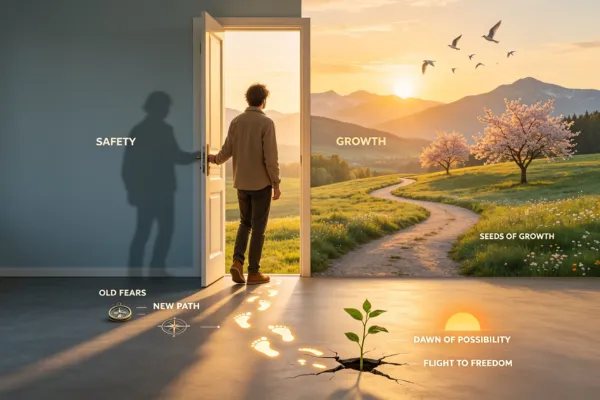
Why Your Fear of Failure Might Actually Be a Fear of Success
Most people accept the idea that fear of failure holds them back. It makes intuitive sense — nobody wants to try something and fall short. But what if the fear running the show isn't really about failure at all? What if, underneath it, you're actually afraid of what success would mean?
This idea feels counterintuitive at first. Who wouldn't want success? But sit with it for a moment, and you may start to recognize it. The project you keep almost finishing. The opportunity you talked yourself out of at the last minute. The relationship you sabotaged when it was going well. The promotion you didn't apply for, telling yourself you weren't ready — even when the evidence said otherwise.
Fear of success is real, it's common, and it's often disguised as something else entirely. Understanding it is one of the most genuinely freeing things you can do for your mental health and your future.

When Fear Wears the Wrong Label
Fear of failure and fear of success can look almost identical from the outside. Both lead to procrastination. Both produce avoidance. Both create a gap between what you want and what you actually pursue. The difference is in what the mind is really protecting you from.
Fear of failure says: What if I try and it doesn't work out?
Fear of success says something quieter and stranger: What if I try and it does?
That second question carries more weight than it appears to. Because success isn't neutral. It comes with changes — in how others see you, in what's expected of you, in who you are to yourself. It can mean leaving behind a version of your life, and even a version of yourself, that felt safe even if it was limiting. And for many people, that prospect is more unsettling than failure.
The mind is extraordinarily creative in hiding this. It will generate very convincing reasons why now isn't the right time, why the goal isn't realistic, why you don't have the right skills yet, why you should wait. These thoughts feel like rational caution. But underneath them, the real driver is often protection from a change that feels threatening.

How the Past Creates Protective Patterns
To understand why success can feel threatening, it helps to look at where these patterns usually begin.
From an early age, your experiences teach you what's safe and what isn't. And some of those lessons were about what happens when things go well.
Maybe your success as a child attracted criticism or jealousy from others. Maybe standing out felt dangerous — it led to pressure, expectations you couldn't sustain, or resentment from people around you. Maybe you watched someone you love achieve something significant and then lose it, and your mind filed that away as: The higher you go, the harder the fall. Maybe success meant changing in ways that threatened your belonging to a group or family system that valued sameness.
None of these conclusions were wrong at the time. They were your mind doing what it does best — learning from experience and creating rules to keep you safe. The problem is that those protective rules rarely get updated as you grow. They stay in operation long after the original threat has passed, quietly steering you away from anything that resembles what once felt dangerous.
Consider someone like Maya. She was bright, driven, and genuinely talented — but every time she got close to a meaningful goal, she'd find a way to undercut herself. She'd miss a deadline she could easily have met. She'd downplay her work to colleagues. She'd choose the safer option at exactly the moment the bigger one was available. From the outside, it looked like a fear of failure or a lack of confidence. But when she explored it more honestly, she found something different: as a teenager, excelling at school had made her the target of relentless mockery from friends who felt left behind. She'd learned, deeply, that succeeding meant losing people she loved. That old lesson was still running the show twenty years later.
Your version of that story may be different. But if you've ever noticed a pattern of pulling back right when things were going well, it's worth asking whether success, at some level, feels like a risk your mind decided to avoid.

The Hidden Benefits of Staying Stuck
Here's something that might be uncomfortable but is worth sitting with: staying stuck often serves a purpose. Not consciously, and not in a way that makes it a deliberate choice — but staying where you are has benefits, and your mind knows it.
These are sometimes called "secondary gains" — the unintentional rewards of not changing.
Staying stuck might mean:
You never have to find out whether you'd have succeeded
You avoid the pressure and expectations that come with achievement
You maintain familiar relationships that might shift if you grew beyond them
You keep a sense of identity that feels secure, even if limiting
You avoid the vulnerability of truly committing to something that matters
None of this is weakness. It is the mind managing perceived risk the best way it knows how. But when you can name the hidden benefit of staying where you are, the pattern loses some of its unconscious power. It shifts from something that happens to you into something you can make a conscious choice about.
A useful question to ask yourself: If I achieved this goal, what would I be afraid of losing? The answer to that question is often more illuminating than any amount of analysis about why you haven't achieved it yet.

A Visualization Exercise to Safely Explore Your Successful Future Self
One of the most effective ways to begin loosening the grip of success-fear is to gently introduce your nervous system to the experience of succeeding — in a safe, low-stakes way. This visualization exercise does exactly that.
Find a quiet place where you won't be interrupted. Sit comfortably, and take five slow, deep breaths — in through the nose, out through the mouth. Let your body settle.
Step 1: Choose the goal.
Bring to mind one specific goal or aspiration that feels exciting but that you've been avoiding or undermining. Keep it to one thing — concrete, meaningful, real.
Step 2: Step into the future.
In your mind, imagine yourself one year from now — having taken steps toward that goal. You don't have to imagine perfection or complete achievement. Just progress. Imagine waking up on an ordinary day in this future version of your life. What does the morning feel like? What has changed?
Step 3: Inhabit it fully.
Walk around in this future moment. What do you see? What do you hear? What does it feel like in your body to be someone who is moving toward what matters to you? Stay with it for a minute or two and allow the emotional tone to register — not just as a mental image, but as a felt experience.
Step 4: Notice the resistance.
At some point, you may notice a sense of discomfort, doubt, or a quiet voice saying This isn't realistic or Don't get your hopes up. That's normal. When it arrives, don't fight it. Simply acknowledge it: There it is — my mind keeping me safe. Then gently return your attention to the future image.
Step 5: Ask one question.
Before you open your eyes, ask yourself: What is one small thing the person in this image has done that I haven't allowed myself to start yet?
Open your eyes slowly. Write down whatever came up.
This exercise doesn't override fear overnight. But it does something important: it familiarizes your nervous system with the territory of success. The more familiar something feels, the less threatening it becomes. Repetition of this practice, even briefly and regularly, gradually shifts success from something abstract and frightening into something the mind begins to recognize as possible — and safe.
Steps to Dismantle the Fear and Move Forward
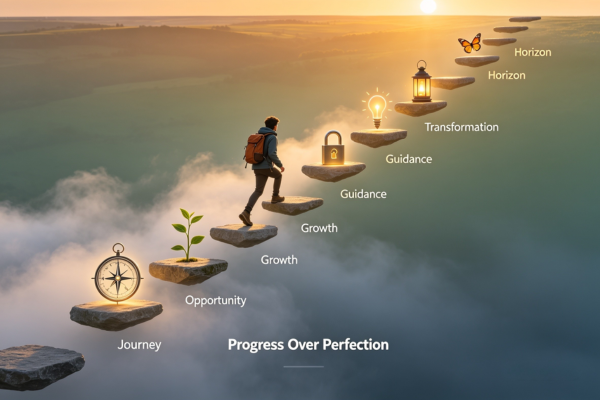
Insight alone doesn't create change, but it makes change possible. Here are practical steps to begin moving from awareness into action.
1. Name the real fear.
Now that you understand the distinction, ask yourself honestly: Is what's holding me back fear of failing, or fear of what succeeding would mean? You don't have to have a perfect answer. Just sitting with the question opens something.
2. Identify the old rule.
What experience or message taught you that success was risky or costly? You may not find a single clear answer, but look for themes. When did you first learn to hold back?
3. Update the rule.
Ask: Does that rule still apply to my life now? In most cases, you'll find it doesn't — at least not in the same way. You have more resources, more autonomy, and more capacity to handle change than you did when the rule was written. Acknowledging this explicitly helps loosen its hold.
4. Start smaller than feels necessary.
The antidote to paralysis is motion — specifically, motion that feels manageable. Identify the smallest possible step toward your goal that your mind can't convincingly argue against. Make it almost ridiculously small. Do that one thing. Then do the next.
5. Let the evidence speak.
As you take small steps and nothing terrible happens, you begin building a new data set. Each time you move toward your goal and survive — even thrive — you are giving your nervous system proof that the old rule isn't the whole truth. Over time, that proof matters more than any amount of reasoning.
6. Expect the pattern to resurface.
Dismantling a deep protective pattern isn't a one-time event. There will be moments when you pull back again, when the old fear rises and a familiar excuse appears. This isn't failure. It's the process. When it happens, use it as information rather than proof that change is impossible.

You Were Made for More Than Safety
Staying safe is not the same as living fully. Your mind has done a remarkable job of protecting you from perceived threats — including the threat of your own success. That deserves some compassion, not criticism.
But you are not in the same place you were when those protective patterns were built. You have the awareness now to see what's been happening, and awareness is the beginning of everything.
The goal isn't fearlessness. Fear is a natural part of growth, and you don't need to eliminate it before you move forward. You just need to recognize it for what it is — and decide, consciously, to take the next step anyway.
The life you've been imagining isn't waiting on the other side of perfect conditions. It's waiting on the other side of one honest decision — to stop letting an old story about safety determine the size of your future.
That decision is available to you right now. And you are more ready for it than you think.
