
Why Rest Feels Uncomfortable — And How to Sit With It
You finally have a free afternoon. No meetings, no obligations, nowhere you need to be. You sit down on the couch, and within minutes, a familiar restlessness creeps in.
I should be doing something. I'm wasting time. There's so much I could be getting done.
If this sounds familiar, you're not lazy, broken, or unusually anxious. You're experiencing something a lot of people feel but rarely talk about: the discomfort of rest.
For many of us, stillness doesn't feel peaceful. It feels threatening. And that's worth understanding — because if rest consistently makes you feel worse instead of better, something deeper is going on. In this post, we'll look at why rest feels so hard, what's really driving that discomfort, and how to start rebuilding a relationship with doing nothing that actually feels like relief.

The Uncomfortable Truth About Rest
Most of us grew up in environments — schools, families, cultures — where being busy was praised and being idle was suspect. Productivity became a measure of worth. Doing more meant being more.
That message doesn't disappear when you become an adult. It gets internalized. And once it's inside you, rest stops feeling like a reward and starts feeling like a risk.
The result is that even when rest is available, you can't quite access it. Your body sits still, but your mind keeps moving. You scroll, reorganize, make lists, find small tasks. Anything to avoid the discomfort of simply being.
Here's the uncomfortable truth: stillness reveals what busyness hides. When there's nothing to do, there's nothing to distract you from what you're feeling — the worry you've been pushing aside, the loneliness you haven't acknowledged, the question about your life you've been too busy to ask.
Rest doesn't create those things. It just makes them visible.
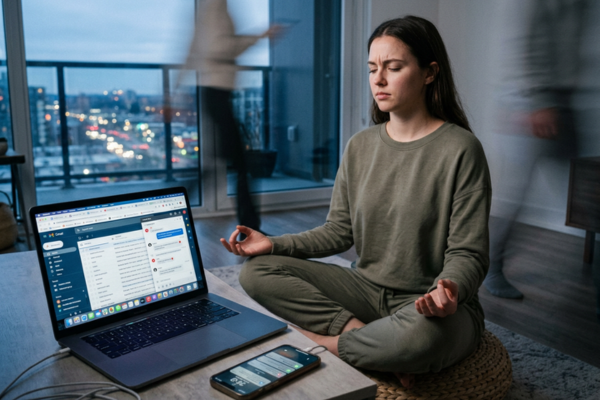
Why Your Nervous System Resists Stillness
There's a physiological layer to this too. When you've spent a long time operating in a high-stress, high-output mode, your nervous system adapts. It gets used to activation — the low hum of urgency, the sense that there's always something to respond to.
When you suddenly remove that stimulation, your nervous system doesn't immediately know what to do. The quiet feels wrong, even dangerous, because your body has been calibrated to interpret activity as safety.
This is why the first few minutes of rest can actually feel more anxious, not less. You haven't done anything wrong. Your system is just recalibrating — slowly learning that it's okay to put the weight down.
The Role of Guilt in Restlessness
Guilt deserves its own mention here, because it's one of the most common reasons rest feels so uncomfortable.
A lot of people don't just feel restless when they stop — they feel guilty for stopping at all. Like resting is something you have to earn through enough suffering first. Like you haven't been productive enough to deserve a break. Like everyone else is hustling and you're falling behind.
That guilt isn't a moral signal. It's a conditioned response. And recognizing it as conditioning — rather than truth — is one of the most freeing things you can do.

Common Signs You've Lost Touch With Rest
You might have a complicated relationship with rest if:
You feel a surge of anxiety when you have unstructured time
You struggle to enjoy leisure without feeling like you should be doing something else
You only allow yourself to rest when you're completely exhausted
You feel more comfortable being busy, even when you don't want to be
You describe your value in terms of what you produce or accomplish
Vacations or weekends off make you feel more stressed, not less
None of these are character flaws. They're patterns — and patterns can be changed.

What Rest Actually Is (And Isn't)
Part of the problem is that most of us have a pretty narrow idea of what rest means. We think it means lying down doing nothing. And if that doesn't come naturally, we assume we're just not wired for it.
But rest isn't one-size-fits-all. There are different kinds of rest that address different kinds of depletion:
Physical rest — sleep, lying down, light stretching
Mental rest — stepping away from problem-solving, decision-making, and information intake
Sensory rest — reducing stimulation: screens, noise, bright lights
Creative rest — spending time in nature, with beauty, or with things that inspire without demanding output
Social rest — time alone, or time with people who don't require you to perform
Emotional rest — space to feel without needing to manage others' feelings at the same time
If physical rest leaves you still feeling drained, you might actually be depleted in one of the other areas. Sleeping more won't fix mental exhaustion if you wake up and immediately open your inbox.
Mini takeaway: Rest is whatever genuinely restores you — not whatever looks restful from the outside.
How to Start Sitting With Stillness
The goal isn't to suddenly love doing nothing. It's to build a tolerance for it — slowly, without forcing it.
1. Start with micro-pauses
You don't have to block out a whole afternoon. Start with two or three minutes of intentional stillness. Sit with your coffee without your phone. Stare out the window between tasks. Walk without headphones. These small moments train your nervous system to experience rest as safe.
2. Name the discomfort instead of running from it
When restlessness shows up, try naming it out loud or on paper: "I feel restless. I have an urge to find something to do." Simply observing the feeling without acting on it — without grabbing your phone or making a to-do list — creates a small but meaningful separation between the impulse and the behavior.
You're not fighting the discomfort. You're just not automatically obeying it.
3. Lower the stakes of rest
Rest doesn't have to be restorative every single time, especially at the start. It just has to be intentional. Give yourself permission to rest badly — to feel uncomfortable, bored, or restless during it — and count that as a win anyway. You showed up for stillness. That's enough.
4. Remove the performance from leisure
Watch the show without also scrolling your phone. Read the book without tracking your page count. Take the walk without logging the steps. When you layer productivity metrics on top of leisure, you undermine the restoration it could offer. Let rest be unproductive. That's the whole point.
5. Examine the belief underneath the guilt
When the guilt shows up, try asking: What am I afraid will happen if I rest? The answer is usually revealing. "I'll fall behind." "People will think I'm lazy." "I'll lose my edge." These beliefs are worth examining — because they're often driving a pace that isn't actually sustainable, or even necessary.

When Stillness Brings Up Difficult Feelings
Sometimes rest is uncomfortable not because of guilt or habit, but because it opens the door to emotions you've been too busy to feel. Grief. Loneliness. Fear. A quiet sadness you can't quite name.
If that happens, it doesn't mean rest is bad for you. It means your mind has been waiting for a window.
You don't have to process everything at once. You don't have to sit in pain. But gently acknowledging what surfaces — rather than immediately flooding it back out with noise — allows something to move that might have been stuck.
If you notice that stillness consistently brings up overwhelming feelings, talking to a therapist or counselor can offer a supportive space to work through what's coming up.

The Relationship With Rest You Deserve
Rest isn't a reward for the exhausted. It isn't something you earn after enough suffering. It's a basic need — as fundamental as food or water — and you are allowed to access it before you've reached your limit.
The goal isn't to become someone who loves doing nothing. It's to become someone who can tolerate stillness without it feeling like a threat. Someone who can let a quiet afternoon be quiet, without guilt hijacking the whole thing.
That shift doesn't happen overnight. But it starts with noticing the discomfort, understanding where it comes from, and choosing — slowly, imperfectly — not to let it make every decision for you.
Here's your one next step: This week, carve out 10 minutes of intentional, unstructured time. No phone, no tasks, no agenda. When the discomfort comes — and it probably will — just name it. You don't have to fix it. You just have to stay.
That's where the relationship with rest begins.
