
What Your Anger Is Really Trying to Tell You
There's a moment most of us know well. Something happens — a comment, a situation, an injustice — and before you've had time to think, heat rises in your chest, your jaw tightens, and the words forming in your mind are anything but calm. Afterward, whether you said those words or swallowed them, you're often left with a residue of shame or confusion. Why did I react like that? What's wrong with me?
Here's what's worth knowing: probably nothing is wrong with you. Anger is one of the most misunderstood emotions in human experience, and the shame we attach to it often prevents us from understanding what it's actually trying to communicate. When you learn to listen to anger rather than fight it or be ruled by it, something shifts. It stops being an enemy and becomes something genuinely useful — a signal, a compass, and sometimes even a source of meaningful energy for change.
This post is about learning that skill.

Anger Is Not a Character Flaw
Before anything else, let's clear the air about what anger actually is.
Anger is an emotion — a natural, biological response that every human being experiences. It evolved for good reasons. It signals that something feels threatening, unjust, or wrong. It mobilizes energy and attention. In the right circumstances, it has protected people, driven social reform, motivated people to leave harmful situations, and inspired extraordinary acts of courage.
The problem isn't anger itself. The problem is what we do with it — and, more often, what we don't do with it.
Most of us received very little education about anger growing up. The messages we absorbed were usually one of two extremes: either suppress it completely (don't make a scene, don't be so dramatic, calm down) or express it in ways that caused damage (shouting, shutting people out, saying things that couldn't be unsaid). Very few people were ever taught to actually understand it.
So it's no wonder that many people relate to their own anger with a mixture of fear and shame. They either push it down until it finds another way out, or they're swept along by it in ways they later regret. Neither approach works, because neither approach treats anger as the information it actually is.
When you start treating anger as a messenger rather than a problem, the entire relationship changes.
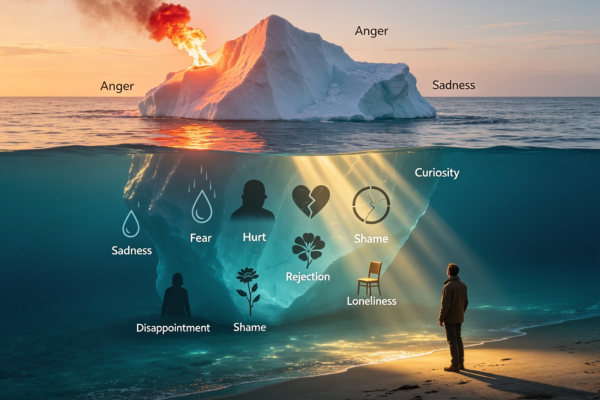
What's Usually Hiding Underneath Anger
Anger is rarely the deepest layer of what's going on. In most cases, it sits on top of other emotions that are more vulnerable and harder to name. In the world of emotional experience, anger is often described as a secondary emotion — one that arrives in response to something more raw underneath.
The emotions most commonly hidden beneath anger include:
Hurt. Someone said something dismissive, broke a promise, or treated you as less than you deserved. The hurt arrived first, but it was quickly covered by anger because hurt requires vulnerability, and vulnerability feels unsafe.
Fear. Anger and fear are closely related. When something feels out of control — a health scare, a financial worry, an uncertain relationship — fear can quickly translate into irritability or rage. The anger provides a sense of agency that the fear doesn't.
Grief. Losses of all kinds — people, opportunities, ideals — can surface as anger. It's often easier to feel furious than heartbroken.
Shame. When something touches a deep sense of inadequacy or failure, shame can transform into defensive anger almost instantly. The anger protects the wound.
Unmet needs. Chronic frustration, resentment, and irritability are often signs that something important — rest, respect, connection, autonomy, safety — has been going unmet for a long time.
Here's a brief example. Marcus had a short fuse at home. After long days at work, the smallest things would set him off — dishes left in the sink, a vague answer from his partner, a plan that changed last minute. He labeled himself "an angry person" and felt guilty about it constantly. But when he started to look past the surface, he found something different: he was exhausted, felt unappreciated, and had spent years prioritizing everyone else's needs while quietly setting aside his own. The anger wasn't the problem. It was the alarm going off because something real had been ignored for far too long.
Understanding what sits beneath your anger doesn't excuse reactive behavior. But it does make the path forward much clearer.

How to Pause and Decode the Message
The gap between feeling angry and acting on it is where everything important happens. That gap might be a fraction of a second when you're highly reactive, or it might be several seconds when you're more regulated. The goal is to expand it — and to use it.
Here is a practical process for doing exactly that.
Step 1: Notice the physical signal first.
Anger has a physical signature before it becomes a thought. Common signals include heat rising in the face or chest, a tightening in the throat or jaw, clenched fists, a sudden rush of energy, or a constricting feeling in the belly. When you learn to recognize your body's specific anger signal, you get a head start before the emotion reaches full intensity.
Practice noticing: Where does anger show up in my body? Not the thought, not the reaction — the physical sensation that arrives first.
Step 2: Name it without judgment.
When you feel the signal, simply name it internally: I'm angry right now. This sounds almost too simple, but naming an emotion activates the part of your brain responsible for reflection, creating a small but meaningful buffer between feeling and reaction. "I'm angry" is a statement of observation. It isn't a license to act, and it isn't a verdict on your character.
Step 3: Create space before responding.
Take one slow, deliberate breath. If you can, physically step back from the situation — leave the room for two minutes, take a walk, splash cold water on your face. This isn't avoidance; it's regulation. You cannot decode the message your anger is carrying if you're still in the flood of it.
If stepping away isn't possible, stay silent for a few seconds longer than feels comfortable. Most of the things people later regret saying were said in the first ten seconds.
Step 4: Ask the decoding questions.
Once you've created even a small amount of space, ask yourself:
What just happened that triggered this?
What emotion might be beneath the anger? Am I actually hurt, afraid, ashamed, or exhausted?
What need of mine feels unmet right now?
What is my anger trying to protect or communicate?
You don't need perfect answers. Just the act of turning curious rather than reactive shifts your internal state and gives you something useful to work with.

Healthy Tools for Releasing Anger's Energy
Understanding anger intellectually is valuable. But anger also carries physical energy — and that energy needs somewhere to go. Suppressing it doesn't dissolve it; it just drives it underground, where it tends to resurface as anxiety, physical tension, or sudden explosions over small things.
The following approaches help release the physical charge of anger in ways that don't cause harm.
Physical movement. Anger is mobilizing energy — it's designed to fuel action. Channeling it into movement is one of the most direct routes to release. A brisk walk, a run, vigorous housework, dancing, hitting a pillow, or any form of exercise that uses your whole body can discharge the tension effectively. You don't need a gym — even ten minutes of intentional physical movement after a triggering event can meaningfully reduce the intensity.
Expressive writing. Write it all down — uncensored, without editing. Not for anyone to read, not for performance, but to move the emotion out of your body and onto the page. Write the angry letter you'll never send. Let yourself say in writing what you wouldn't say out loud. This creates discharge without damage, and often reveals clarity about what you actually need.
Vocal release in private. Sometimes anger needs a voice. Shouting into a pillow, singing loudly in the car, or simply allowing yourself to speak your frustration aloud — to no one in particular — can release pressure in a way that silent processing sometimes can't.
Grounding breath. When anger is present but a situation requires you to stay composed — a work meeting, a conversation with a child, a public setting — use a slow, extended exhale to reduce the physiological intensity. Breathe in for four counts, hold briefly, and exhale slowly for six counts. This directly calms the nervous system without requiring you to leave the situation.
Talking to someone you trust. Being genuinely heard often deflates anger faster than almost anything else. Not someone who will add fuel to the fire or dismiss your feelings — someone who can hold space for what you're feeling without judgment. That kind of witnessing is itself a release.

Turning Anger Into Fuel for Constructive Change
Here's the part about anger that doesn't get enough attention: it can be profoundly useful.
When understood and channeled wisely, anger is one of the most powerful catalysts for change available to a human being. It carries energy, clarity, and conviction. The key difference between anger that destroys and anger that builds is direction — whether you aim it outward in ways that cause damage, turn it inward against yourself, or redirect it toward something meaningful.
Ask yourself: What would it look like to use this energy constructively?
If you're angry about an injustice, what action could you take? If you're angry because a boundary has been repeatedly ignored, what would it look like to communicate that boundary clearly, firmly, and calmly? If chronic anger is pointing to a situation in your life that isn't working — a relationship, a job, a pattern — what honest step could you take toward changing it?
Some of the most significant changes people make in their lives — leaving a job that was depleting them, ending a relationship that wasn't healthy, finally speaking up about something that mattered — were fueled by anger that was eventually understood rather than suppressed or scattered.
The emotion that society has taught you to hide or be ashamed of may be the very one signaling that something genuinely important needs your attention.

A Final Word: Your Anger Deserves Respect
Anger doesn't make you a bad person. It makes you a human one. And like every emotion, it deserves to be met with curiosity rather than shame — because underneath it, there is almost always something worth understanding.
You don't have to be perfect at this. The next time anger arrives, you probably won't immediately go into calm, curious observation mode. That takes practice, and practice takes time. But every moment you choose to pause, even briefly, before reacting — every time you ask What is this really about? instead of acting on the first impulse — you are building something valuable. A different relationship with one of your most powerful emotions.
Over time, that relationship can shift from one of shame and reactivity to one of respect and intention. And from that place, anger stops being something that happens to you and becomes something that informs you — a signal worth listening to, and sometimes a force worth using.
You have every right to feel what you feel. Now you also have a way to understand it.
