The Breathing Trick That Interrupts Anxiety in Under Two Minutes
You know the feeling. Your heart picks up speed. Your chest tightens. Your thoughts start racing, jumping ahead to worst-case scenarios before you've had a chance to think clearly. Maybe it happens before a difficult conversation, during a stressful commute, or seemingly out of nowhere at two in the afternoon on a perfectly ordinary day.
Anxiety has a way of arriving fast and uninvited. And when it does, it can feel like there's very little you can do except wait it out.
But there is something you can do — something immediate, portable, and surprisingly effective. It involves nothing more than the breath you're already taking. With a specific breathing pattern, you can send a direct signal to your nervous system to stand down — and you can begin to feel the difference in under two minutes.
This post explains how that works, walks you through the technique step by step, and shows you how to make it even more powerful with one small addition.
What Anxiety Actually Does to Your Nervous System
To understand why breathing works, it helps to understand what anxiety is doing in the body.
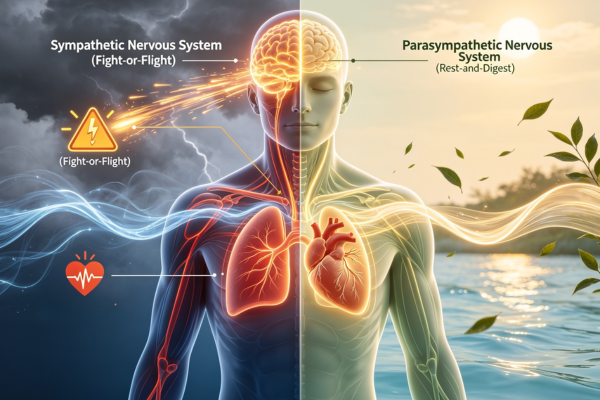
Your nervous system has two primary operating modes. The first is the sympathetic mode — often called the "fight-or-flight" response. When your brain detects a threat, real or perceived, this system activates. Your heart rate increases, your breathing becomes faster and shallower, stress hormones flood your bloodstream, and your muscles prepare for action. This is an ancient, intelligent survival mechanism.
The second mode is the parasympathetic response — sometimes called "rest and digest." This is the system responsible for calm, recovery, and clear thinking. When it's active, your heart rate slows, your digestion resumes, your muscles relax, and your mind regains access to rational thought.
Here's the problem with anxiety in modern life: your brain doesn't always distinguish well between a genuine physical threat and a stressful email. It fires the same alarm system for both. And once that alarm fires, your breathing pattern shifts automatically — it becomes faster, shorter, and higher in the chest. This shallow breathing then feeds the system a signal that reinforces the anxiety: Something is wrong. Stay alert.
This is the feedback loop that makes anxiety self-sustaining. You feel anxious, your breathing shallows, and the shallow breathing tells your body to remain on guard.
The good news is that the loop works in reverse. By deliberately changing your breathing pattern, you can send a direct physiological signal to the parasympathetic system — essentially telling your nervous system: The threat has passed. You can stand down. Your body listens. It has to, because breathing is one of the few autonomic functions you can consciously control.
The Breathing Pattern That Creates Calm
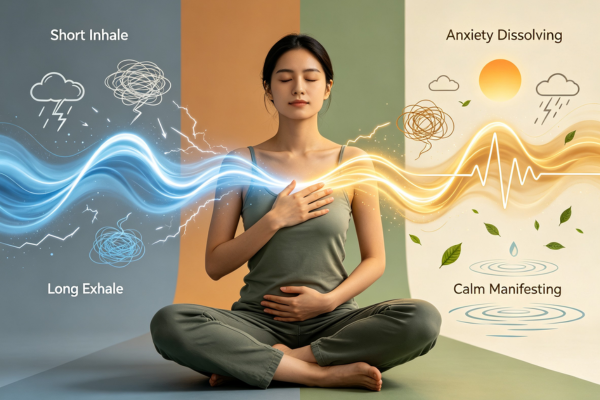
The technique described here is built on one central principle: a longer exhale than inhale activates the parasympathetic response more quickly than any other component of the breath cycle. The exhale is where the calming happens.
This breathing sequence is sometimes called extended exhale breathing or a variation of box breathing, but the specific version here is designed for fast anxiety interruption rather than long practice sessions. It takes roughly 90 seconds to two minutes to complete one full cycle, and most people notice a shift within that time.
Here are the steps.
Step 1: Find a position that allows your chest to open.
You can do this sitting, standing, or lying down. If you're sitting at a desk or in a car, sit up slightly rather than slumping. You don't need to look like you're meditating — just create a little space for your breath to move.
Step 2: Take one clearing breath.
Breathe in through your nose for a count of two, then let everything out through your mouth with a slow, audible sigh. Let your shoulders drop as you exhale. This single breath begins to interrupt the shallow breathing pattern and signals to your body that something is about to shift.
Step 3: Begin the patterned sequence.
Inhale slowly through your nose for a count of four.
Hold gently at the top for a count of two. Don't force this — it should feel easy, not tense.
Exhale slowly through your nose or mouth for a count of six.
Pause naturally at the bottom for a count of two before beginning the next inhale.
That completes one breath cycle. The full pattern is 4-2-6-2.
Step 4: Repeat five to six times.
Five to six complete cycles takes approximately 90 seconds to two minutes. With each exhale, allow your jaw to soften, your shoulders to settle, and your belly to gently release. You don't need to force relaxation — just allow the breath to do its work.
Step 5: Return to natural breathing.
After completing the cycles, let your breath return to its own rhythm without effort. Notice how your body feels compared to when you began.
A Relatable Example
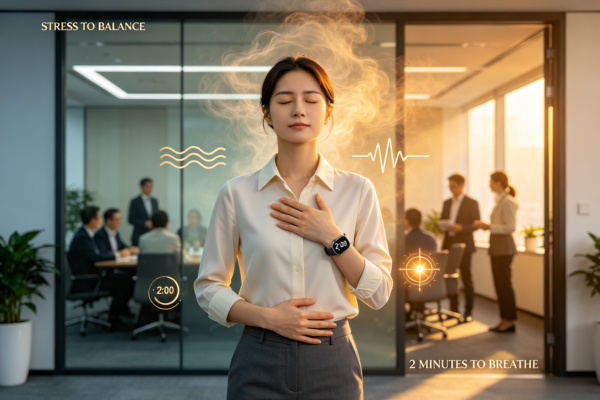
Consider someone like Rachel. She's a secondary school teacher who manages her classroom well but has always struggled with anxiety before staff meetings — particularly ones where she might be called on to speak in front of senior leadership. Her heart would race on the walk down the corridor, her thoughts would scatter, and by the time she sat down she felt visibly flustered.
After learning this breathing sequence, she started doing it in the final two minutes before every meeting — sitting in her car or standing in a quiet corner of the hallway. She didn't need privacy or special equipment. She just needed her breath and two minutes.
Within a few weeks, she noticed a real shift. The anxiety didn't disappear entirely, but it stopped peaking the way it had before. She arrived in the room calmer, thought more clearly, and felt more like herself. The meetings hadn't changed. Her nervous system's starting point had.
That's what this technique offers — not the elimination of anxiety, but a reliable way to lower its volume before it takes over.
When and Where to Use It for Best Effect
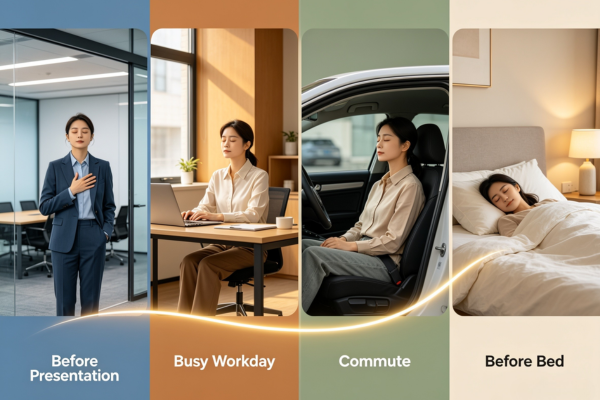
One of the greatest strengths of this technique is its portability. You can use it virtually anywhere, and it requires nothing but a couple of minutes and your own breath.
Before high-pressure situations. Use it before a job interview, a difficult conversation, a presentation, a medical appointment, or any moment you're anticipating with dread. Starting from a calmer baseline makes a genuine difference in how you perform and how you feel.
At the first sign of anxiety rising. Don't wait until the anxiety is at its peak. The earlier you use the technique in the anxiety cycle, the more effectively it can interrupt it. When you notice your chest tightening, your thoughts speeding up, or your breathing becoming shallow — that's the signal. Start the pattern there and then.
During a break or transition. If you can't step away in the moment, use the technique during a natural pause — a bathroom break, the gap between meetings, a moment in the car before you go inside. These transition points are often underused opportunities to reset.
Before sleep. Anxiety frequently peaks at night when the day's stimulation has faded and there's nothing left to distract from unresolved worry. Running through five or six cycles of this breathing pattern while lying in bed can shift your nervous system into a state more conducive to sleep.
As a regular practice, not just a crisis tool. The technique is most powerful when you use it consistently, not only when things are difficult. Regular use builds what might be called a "calm baseline" — a nervous system that spends more time in the parasympathetic mode overall, which means anxiety has less ground to take when it does arrive.
Adding a Mental Anchor Word for Faster Results
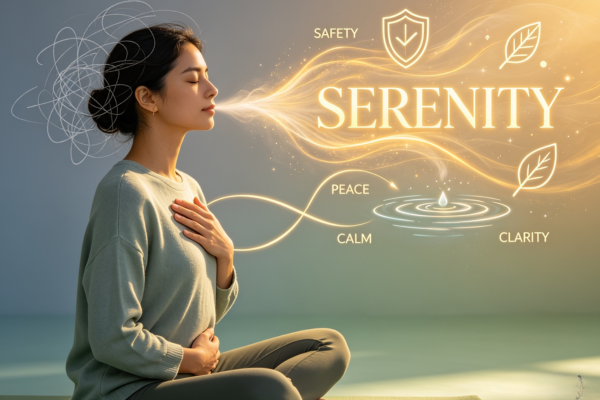
Once you've practiced the breathing pattern a handful of times and feel familiar with it, you can deepen its effect by pairing it with what's sometimes called an anchor word — a single word or short phrase you mentally repeat during the exhale.
The principle is straightforward. When you consistently pair a calm physical state with a specific word, your brain begins to associate that word with the calm state. Over time, simply thinking or quietly saying that word — even without the full breathing sequence — can begin to cue the relaxation response.
Here's how to do it:
Choose a word that feels genuinely calming to you. Simple words work best — release, calm, ease, settle, safe, still. Avoid anything that feels forced or artificial. The word should feel neutral or gently positive when you think it.
Once you've chosen your word, begin incorporating it into the breathing sequence. As you exhale on each breath cycle, mentally or quietly say your anchor word. Let it arrive as the air leaves your body — release... release... release... with each long exhale.
Continue this for your full five to six cycles.
After several sessions of consistent practice — usually within a week or two of daily use — you'll begin to notice that hearing or thinking your anchor word starts to soften the edges of anxiety on its own. It doesn't replace the breathing, but it gives you an additional tool that's even more discreet and instant.
Consider this: if you're in a meeting or a social situation where you can't visibly focus on your breath, you can internally say your anchor word on a slow exhale, and your nervous system will respond — because you've trained it to.
A Few Things to Keep in Mind
This technique is genuinely helpful for everyday anxiety and stress, and many people find meaningful relief from it. That said, it's worth being honest about what it is and what it isn't.
It is a tool — a reliable, evidence-supported method for interrupting the anxiety cycle and inviting calm. It works with your body's own biology rather than against it.
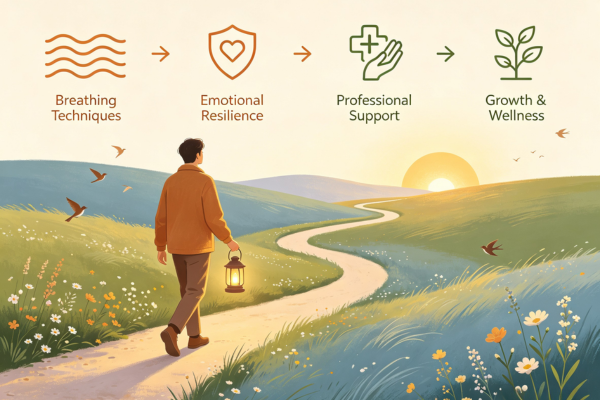
It is not a cure for clinical anxiety disorders. If your anxiety is persistent, significantly disrupting your daily life, or accompanied by other symptoms that concern you, please reach out to a healthcare professional. Breathing techniques can be a valuable part of a broader support plan, and there is no shame in needing more than one kind of help.
Also, occasionally people feel slightly lightheaded when first trying slow breathing exercises. If that happens, return to your natural breathing rhythm and try again with slightly less depth on the next attempt. The goal is ease, not effort.
You Already Have What You Need
There's something genuinely hopeful about the fact that one of the most effective tools for interrupting anxiety is already inside you. It doesn't require a prescription, an app, or a particular environment. It requires only your attention and a few conscious breaths.
Anxiety tends to make the world feel small and overwhelming. This technique is a reminder that you are not powerless in the face of it. You have direct access to your own nervous system, and with practice, you can learn to use that access intentionally.
Two minutes. Five to six breath cycles. A single anchor word.
It's a small investment for something that can genuinely change the quality of your day — and over time, the quality of how you move through the world.
Start today. Your next calm breath is already waiting.
