
How to Stop People-Pleasing Without Feeling Guilty
How to Stop People-Pleasing Without Feeling Guilty
You say yes when you mean no. You soften your opinions to avoid conflict. You spend hours after a difficult conversation wondering if you upset someone — even when you did nothing wrong.
If this sounds familiar, you're not alone. People-pleasing is incredibly common, and it often goes unnoticed for years because it looks like kindness from the outside. But there's a difference between being genuinely generous and shrinking yourself to manage other people's comfort.
This post is for anyone who's starting to notice the cost of always putting others first. Here's what we'll cover:
Why people-pleasing happens and where it comes from
How to recognize it in your own behavior
The guilt that comes with changing those patterns
Practical ways to start saying no — with kindness and without apology

What People-Pleasing Actually Is
People-pleasing isn't just being nice. Most people who struggle with it are genuinely caring, empathetic, and warm. The difference lies in the motivation underneath the behavior.
When you do something kind because you want to, that's generosity. When you do something because you're afraid of what happens if you don't — the disapproval, the conflict, the loss of connection — that's people-pleasing. The action might look identical from the outside. The internal experience is completely different.
Where It Usually Starts
For most people, people-pleasing developed early. Maybe you learned that keeping the peace at home made things safer. Maybe your needs were dismissed or treated as inconvenient, so you stopped expressing them. Maybe you were praised for being "easy" and "low maintenance" — and internalized that being easy was how you earned love.
Over time, that adaptive behavior becomes automatic. You stop noticing you're doing it. You just feel an almost reflexive pull to accommodate, smooth things over, and make sure everyone around you is comfortable — often at the expense of your own needs.
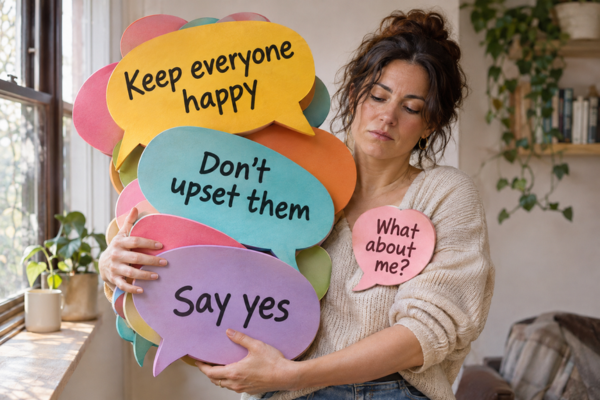
Signs You Might Be a People-Pleaser
People-pleasing doesn't always look dramatic. Often it shows up in small, everyday patterns:
Saying yes to things you genuinely don't want to do, then feeling resentful about it later
Apologizing constantly, even when you've done nothing wrong
Struggling to express opinions or preferences when you sense others might disagree
Feeling responsible for other people's moods
Changing your behavior or personality depending on who you're with
Feeling anxious after any conflict — even a minor one — for hours or days
Waiting to see what others want before saying what you want
Any one of these on its own isn't a sign of a deep problem. But if several feel like consistent, recurring patterns, you're likely managing your relationships through accommodation rather than authenticity.
The Real Cost of Always Saying Yes
The short-term reward of people-pleasing is real. Conflict is avoided. People seem happy. The tension stays low. But the long-term cost is significant — and it tends to show up gradually.
Resentment builds quietly. When you consistently give more than you want to give, the gap between what you're offering and what you actually feel creates friction. You might not notice it at first, but over time a low-level resentment can develop toward the very people you've been working so hard to please.
Your sense of self erodes. When you're always adapting to what others need, you can lose track of what you actually think, feel, and want. Your preferences start to feel unclear. Your opinions feel less solid. You become so skilled at reading others that you stop reading yourself.
Relationships stay shallow. Ironically, people-pleasing often prevents real intimacy. When people only ever see your accommodating, agreeable side, they don't really know you. And you can feel profoundly lonely even in the middle of relationships where you're giving everything.
You attract imbalance. Over time, consistently saying yes tends to teach people around you that you don't have limits — which can lead to relationships where more and more is expected, and less and less is given back.
Why Changing Feels So Guilty
Here's one of the most important things to understand: when you start to shift people-pleasing patterns, guilt is almost always part of the process. And that guilt can feel convincing.
When you say no to someone you've always said yes to, it can feel like you're being selfish, cold, or hurtful. That feeling is real — but it isn't necessarily accurate. It's the nervous system responding to the unfamiliarity of a new behavior, not a reliable signal that you've done something wrong.
Guilt after setting a limit isn't proof that the limit was wrong. It's proof that you've been trained to prioritize others' comfort above your own — and that changing that pattern creates temporary discomfort.
The discomfort doesn't mean you should go back. It means the change is real.

How to Stop People-Pleasing — Without Losing Your Warmth
The goal isn't to become someone who doesn't care what others think or who sets limits harshly. The goal is to be genuinely warm and honest — to show up in relationships as yourself rather than as the most accommodating version of yourself.
Start Noticing Before Changing
Before you try to change any behavior, spend a week simply noticing. When do you say yes and immediately feel a quiet dread? When do you apologize out of habit rather than genuine regret? When do you edit your real thoughts before sharing them?
Awareness doesn't require action. But you can't change what you haven't seen clearly.
Buy Yourself Time
One of the most practical tools for people-pleasers is the pause. Instead of automatically agreeing to something, try saying:
"Let me check and get back to you."
"I need a day to think about that."
"I'll let you know by tomorrow."
This creates space between the request and your response — space where you can ask yourself what you actually want, rather than what the other person wants to hear. It's a small habit with a significant impact.
Practice the Short, Kind No
A no doesn't require a lengthy explanation or apology. In fact, over-explaining often signals that you still feel the need to earn permission to have limits.
Some options:
"I can't make that work, but thank you for thinking of me."
"That's not something I'm able to take on right now."
"I'm going to sit this one out."
You don't have to justify your no with an exhaustive list of reasons. A clear, kind response is enough. You're allowed to have limits without proving they're legitimate.
Separate Discomfort From Wrongdoing
After you say no — or express an honest opinion, or take up space in a new way — notice what you feel. If guilt or anxiety shows up, try asking: Did I actually do something wrong, or does this just feel unfamiliar?
Most of the time, the answer is that you did nothing wrong. You just did something new. Sitting with that distinction, even briefly, helps recalibrate the guilt response over time.
Reframe What Kindness Actually Means
People-pleasers often believe that saying yes is kindness. But real kindness includes honesty. When you say yes to something you resent, the resentment doesn't disappear — it shows up in other ways. In passive withdrawal. In quiet frustration. In the flatness that settles over a relationship where one person is always giving more than they have.
Saying an honest no — warmly, clearly, without cruelty — is often more genuinely kind than a resentful yes.

Common Mistakes When Breaking People-Pleasing Patterns
Going from yes to harsh no overnight. This tends to backfire — for you and for the people around you. Gradual, consistent change is more sustainable than dramatic overcorrection.
Expecting others to adjust immediately. People in your life have gotten used to a certain version of you. When you change, some will need time to adjust. Some will push back. Their reaction isn't proof you were wrong — it's a sign the dynamic is shifting.
Treating every moment of discomfort as a sign to retreat. Change is uncomfortable. That discomfort is normal and expected, not a signal to go back to the way things were.
Confusing limits with rejection. Setting a limit is not the same as withdrawing care. You can love someone and still say no to them. In fact, relationships where both people can be honest tend to be far more durable than relationships built on constant accommodation.
