
Overcoming Negativity: How to Reframe Your Thoughts for Success
We all have that inner voice that loves to point out everything that could go wrong. When you face a new challenge, your mind naturally tries to protect you by highlighting potential risks. However, this protective mechanism often spirals into chronic negativity. You find yourself trapped in a loop of self-doubt, focusing on past failures and future catastrophes.
You cannot control every situation you encounter, but you hold complete power over how you interpret those situations. Reframing your thoughts is not about ignoring reality or faking a smile. It is a practical, actionable strategy to train your brain to look for solutions instead of dwelling on problems.
By shifting the questions you ask yourself, you can break free from the cycle of complaining. We will explore how replacing "why" with "what" and "how" transforms your approach to setbacks. We will also dive into the "but what if" strategy, a simple tool to flip your worst-case scenarios into blueprints for success.

The Trap of the "Why" Question
When things go wrong, human nature prompts us to ask, "Why?" You miss a deadline, and you immediately think, "Why do I always mess up?" You face a sudden financial hurdle, and you ask, "Why is this happening to me?"
On the surface, "why" feels like a logical question. You think you are looking for the root cause of the problem. In reality, asking "why" often leads you straight into a venting cycle. It traps you in the past and forces you to justify your negative feelings.
Why "Why" Leads to Venting
When you ask "why," your brain immediately searches for someone or something to blame. You blame your boss, the economy, your lack of sleep, or even your own character flaws. This search for blame creates a victim mentality. You convince yourself that external forces control your destiny.
Venting might feel good for a few minutes. It releases a small amount of emotional pressure. However, it does absolutely nothing to change your situation. You remain stuck in the exact same spot, simply complaining about how you got there.
The Emotional Toll of "Why"
Constantly asking "why" drains your mental energy. It keeps your brain focused on the problem, magnifying the negative emotions attached to the event. You replay the frustrating scenario over and over in your head.
This repetitive thinking increases your stress levels and clouds your judgment. You cannot clearly see a path forward because you are too busy looking backward. To move toward success, you must stop asking questions that invite excuses. You need questions that demand action.
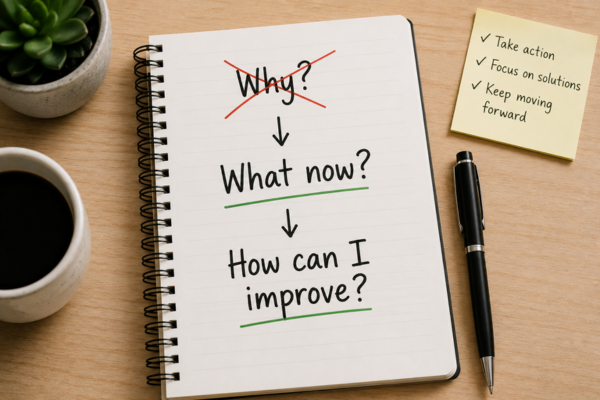
Switching Gears: The Power of "What" and "How"
If "why" is the language of venting, "what" and "how" are the languages of resourcefulness. Successful people do not waste time arguing with reality. They accept the current situation and immediately start looking for the next best step.
Shifting your internal dialogue requires conscious effort. You must catch yourself in the act of complaining and deliberately change the question. This small pivot radically alters how your brain processes the challenge.
Activating Your Problem-Solving Brain
Questions starting with "what" and "how" force you to look forward. They bypass the emotional defense mechanisms and engage the logical, problem-solving areas of your brain.
Instead of asking, "Why did I lose that client?" you ask, "What steps can I take to improve my pitch next time?" Instead of asking, "Why am I so out of shape?" you ask, "How can I fit a twenty-minute workout into my schedule today?"
These resourceful questions remove the judgment from the situation. They treat the failure as a neutral piece of data. You stop feeling sorry for yourself and start gathering the information you need to win.
Building Forward Momentum
"What" and "how" questions demand actionable answers. They break massive, overwhelming problems into small, manageable tasks.
When you ask, "What is one thing I can do right now to make this better?" you give yourself immediate agency. You realize that you have the power to influence the outcome. Taking that first small step creates momentum. As you knock out tiny victories, your confidence grows, and the negative thoughts naturally begin to fade.
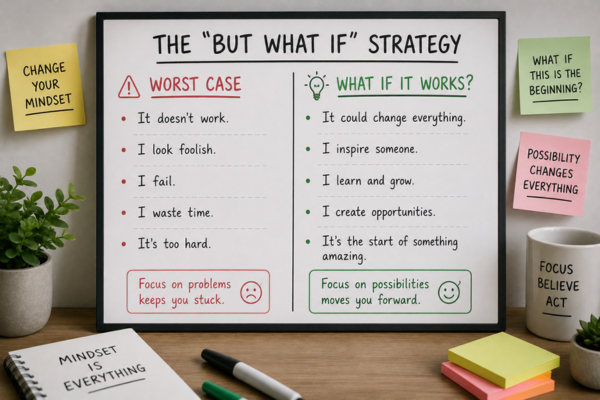
The "But What If" Strategy
Anxiety loves to play the "what if" game. Your mind generates endless worst-case scenarios. "What if I bomb the presentation?" "What if they reject my proposal?" "What if I start this business and go bankrupt?"
This catastrophic thinking paralyzes you. It convinces you that the risk of failure outweighs the potential for success. To combat this, you can use a powerful reframing tool known as the "but what if" strategy.
Flipping the Script
The "but what if" strategy uses your brain's natural tendency to predict the future, but it flips the direction. Whenever you catch yourself spiraling into a negative "what if," you must immediately counter it with a positive alternative.
You catch the thought: "What if I fail this interview?"
You immediately add: "But what if I absolutely crush it and get the job?"
You think: "What if I ask for a raise and my boss says no?"
You counter with: "But what if they say yes, and I finally get the compensation I deserve?"
Training Your Brain for Optimism
This strategy works because it breaks the pattern of one-sided thinking. It forces your brain to acknowledge that a positive outcome is just as mathematically possible as a negative one.
Over time, this practice physically rewires your thought patterns. You start to see opportunities where you previously only saw threats. You realize that your worst fears rarely come true, and even if they do, you have the resilience to handle them. The "but what if" strategy gives you the courage to take the calculated risks required for true success.

Practical Steps to Reframe Your Thoughts Today
Understanding these concepts is the first step, but you must apply them to see real change. You cannot wait for a crisis to practice reframing. You must build the habit during your everyday challenges.
Here are three practical steps to start overcoming negativity and rewiring your mindset for success right now.
Catch the Negative Spiral Early
You cannot change a thought if you do not notice it. Start paying close attention to your internal monologue. Notice the physical signs of a negative spiral. Do your shoulders tense up? Does your breathing get shallow?
When you feel that familiar frustration setting in, hit the pause button. Acknowledge the negative thought without judging yourself for having it. Say to yourself, "I am spiraling into a 'why' loop right now." Awareness is the necessary foundation for change.
Replace the Question Out Loud
Do not just change the question in your head. Say it out loud or write it down. The physical act of speaking or writing engages different parts of your brain and makes the pivot more effective.
If you catch yourself asking a "why" question, physically write out a "what" or "how" question to replace it. Cross out "Why is my team so slow?" and write down, "How can I communicate the deadlines more clearly to my team?" This simple exercise pulls you out of victimhood and places you back in the driver's seat.
Document Your "But What If" Wins
Your brain has a built-in negativity bias. It remembers failures much more vividly than successes. To overcome this, you must actively document your victories.
Keep a small journal or a note on your phone. Every time you use the "but what if" strategy to take a risk, record the outcome. Note the times when things went perfectly. Note the times when things went wrong, but you easily handled the fallout. Reviewing this list builds an undeniable mountain of evidence that positive thinking leads to positive results.

Take Control of Your Narrative
Your thoughts dictate your actions, and your actions dictate your success. If you let negativity run wild, you will constantly sabotage your own potential. You do not have to live at the mercy of your worst fears and frustrations.
Start changing the narrative today. Stop venting about why things are hard. Start asking what you can do about it. When fear tries to hold you back, challenge it with the "but what if" strategy. By deliberately choosing resourceful questions and focusing on positive possibilities, you transform obstacles into stepping stones on your path to success.
