
Emotional Anchoring: How to Call Up Confidence Whenever You Need It
You've felt it before — that rare moment when everything clicks. You're sharp, calm, and fully present. You say the right thing at the right time. You walk into a room and feel genuinely at ease in your own skin. Confidence isn't just a mindset in those moments. It's a felt experience in your body.
Then the moment passes. And the next time you really need that feeling — before a job interview, a difficult conversation, a presentation — it's nowhere to be found.
What if you could reliably call that state back, on demand, whenever you needed it most?
That's exactly what emotional anchoring makes possible. It's a practical, accessible technique grounded in how your brain naturally forms associations — and once you understand it, you can build a personal confidence trigger you carry with you everywhere.
By the end of this post, you'll understand:
What emotional anchoring is and why it works
How to build your own confidence anchor step by step
What mistakes to avoid so your anchor stays strong
How to use it before high-pressure situations

What Emotional Anchoring Actually Is
Emotional anchoring is the process of intentionally linking a physical cue — a touch, a word, a gesture — to a specific emotional state, so that the cue alone can later trigger that state.
You already experience this all the time, just unconsciously. A song from your teenage years brings back a rush of feeling. The smell of a particular food takes you straight back to a childhood memory. A certain tone of voice from someone you love immediately puts you at ease. These are natural anchors — sensory triggers your brain has linked to emotional experiences through repetition.
Emotional anchoring simply makes this process deliberate. Instead of leaving it to chance, you consciously build the connection you want, with the emotional state you choose.
The brain learns through association. When two things consistently occur together — a physical sensation and an emotional state — the brain begins to connect them. Over time, triggering one reliably activates the other. This is the same mechanism behind why certain music energizes you or why the smell of a hospital makes some people anxious. The association was formed through experience, and the brain maintains it.
When you build a confidence anchor, you're using this same mechanism with intention.

How the Brain Links Cues to Emotional States
Your nervous system is constantly filing associations. Every significant emotional experience gets tagged with whatever sensory information was present at the time — what you saw, heard, felt, smelled, or touched. These details become retrieval cues.
When the brain encounters one of those cues again later, it doesn't just remember the experience — it begins to recreate it. That's why anchors feel more powerful than simply thinking about a memory. The physical cue bypasses deliberate thought and speaks directly to the nervous system.
The strength of an anchor depends on a few key factors:
Intensity of the emotional state at the time of anchoring — a deeply felt experience creates a stronger link than a mild one
Distinctiveness of the physical cue — a unique gesture or touch is easier for the brain to associate cleanly than something you do all the time anyway
Repetition — the more consistently you pair the cue with the state, the more automatic the response becomes
This means a well-built anchor gets stronger with use, not weaker. Think of it as a pathway your nervous system learns to travel more easily each time you practice it.
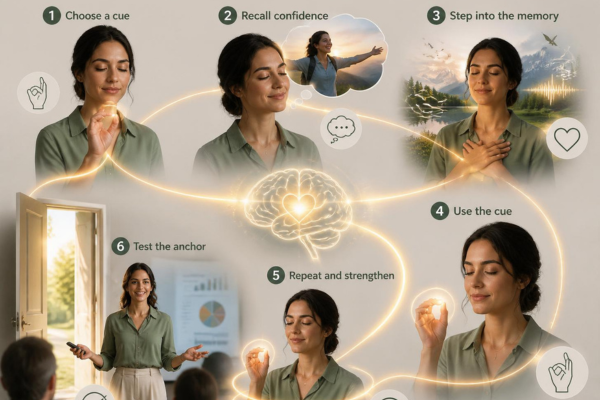
Step-by-Step: How to Create Your Confidence Anchor
This process works best in a quiet place where you won't be interrupted. Set aside 10–15 minutes the first time. Subsequent sessions can be shorter.
Step 1: Choose Your Physical Cue
Your cue needs to be distinctive and within your control in any situation. Good options include:
Pressing your thumb and middle finger together firmly
Touching a specific knuckle with the opposite thumb
Pressing the palm of your hand against your thigh with intention
Gently squeezing your own wrist
Avoid gestures you make habitually throughout the day — the anchor works best when the cue is reserved specifically for this purpose.
Step 2: Access a Genuine Memory of Confidence
This is the most important step. Close your eyes and bring to mind a specific time when you felt genuinely confident. Not a time you performed well despite fear — a time when you actually felt capable, grounded, and present.
It doesn't have to be a dramatic moment. It might be a conversation where you spoke clearly and were truly heard. A day when you solved a problem with ease. A moment of physical competence — sport, creativity, craftsmanship. Choose something that, when you bring it to mind, produces a real felt sense rather than just a visual image.
Step 3: Step Fully Into the Memory
Don't watch the memory like a movie. Step inside it. Recall it as vividly as possible:
What did you see around you? The colors, the faces, the environment.
What did you hear? Sounds, voices, your own inner voice.
What did you feel in your body? Where was the confidence sitting — your chest, your posture, your breath?
Allow the emotional state to build. Take your time. Most people need 30–60 seconds of full immersion before the feeling reaches genuine intensity. Don't rush to the next step.
Step 4: Apply the Physical Cue at Peak Intensity
When the feeling of confidence is at its strongest — not building, not fading, but at the height of the experience — apply your chosen physical cue. Hold it firmly and intentionally for five to seven seconds.
Then release the cue and let the memory fade naturally.
Take a breath, open your eyes, and briefly think about something neutral — a color, what you had for lunch. This "breaks state" and helps keep the anchor clean.
Step 5: Repeat the Process
Repetition is what turns a loose association into a reliable trigger. Repeat the anchoring process at least three to five times in your first session, then return to it over the following days.
Each time you anchor, you can use the same memory or a different one — the key is reaching genuine emotional intensity before applying the cue. Building from multiple strong memories makes the anchor more robust.
Step 6: Test Your Anchor
After three or more repetitions, test it. Clear your mind, think of something neutral, then apply the physical cue. Notice what happens in your body. Most people feel a subtle but recognizable shift — a slight lift in mood, a sense of steadiness, a returning of the feeling they anchored.
If the response is faint, it means more repetitions are needed. Keep building.

Common Mistakes That Weaken Anchors
Getting the basics right is straightforward, but a few common errors can undercut the process. Here's what to watch for.
Applying the cue too early or too late. The timing of when you apply the physical cue is critical. Apply it while the emotional state is still building and you're anchoring the anticipation, not the peak. Apply it after the feeling has already faded and you anchor the decline. Aim for the moment of maximum intensity.
Choosing a cue that's not unique enough. If you press your thumb and finger together while typing, talking, and thinking throughout the day, the anchor will become diluted. Reserve your cue exclusively for this purpose so the association stays clean and specific.
Using surface-level memories instead of genuinely felt ones. An anchor built on a lukewarm emotional recollection will produce a lukewarm response. If you can't feel the confidence when you're anchoring, the brain has little to link the cue to. Take the time to find a memory that genuinely moves you — even if it takes a few attempts.
Giving up after one session. A single anchoring session rarely produces a strong result. Like any training, it needs repetition. Expect to build it over several days before the response becomes consistent and immediate.
Using the anchor constantly for minor things early on. Before your anchor is well-established, firing it repeatedly for low-stakes moments can dilute the association before it's fully formed. Build it first, then begin using it.

A Relatable Example
Claire is a marketing coordinator who is excellent at her job but dreads presenting to senior leadership. The weeks before any big meeting would be marked by poor sleep, circular thinking, and a version of herself she didn't recognize — hesitant, shrinking, second-guessing every word.
She began practicing emotional anchoring using a specific press of her left thumb against the side of her index finger. Her chosen memory was a moment years earlier when she'd presented a project to her university classmates and received a standing ovation. The memory produced a clear, strong feeling of being seen and capable.
Over two weeks of daily 10-minute practice sessions, she built the association until applying the cue produced a reliably noticeable shift in her state — a settling in her chest, a slight straightening of her posture, a quieting of the anxious chatter.
On the day of her next senior presentation, she applied the cue in the elevator on the way up. She didn't feel fearless. But she felt like herself — and that was enough. She presented clearly, handled a challenging question with composure, and left the room knowing she'd done well.
The situation hadn't changed. Her access to her own inner resources had.

How to Use Your Anchor Before High-Pressure Situations
Once your anchor is established, using it before demanding moments is straightforward — but a few habits will make it more effective.
Create a brief pre-event ritual. A minute or two before a high-pressure situation, find a moment of relative quiet — a restroom, a corridor, your car. Take three slow breaths, and then apply your anchor cue. Allow the feeling to arrive before you walk into the room.
Combine it with a grounding breath. Pair the cue application with a single slow exhale. The physical anchor and the deliberate breath work together to settle the nervous system from two directions simultaneously.
Use it as a reset, not just a starter. If you notice your confidence dipping mid-situation — mid-conversation, partway through a presentation — apply your cue discreetly. A thumb press or a quiet touch is invisible to others and can bring you back to a steadier baseline without breaking your flow.
Keep reinforcing it. After a successful experience where your anchor helped, return to your anchoring practice and rebuild the emotional state with that new positive experience included. Your anchor becomes richer over time, drawing on an expanding library of genuine confidence.
You Already Have the Resources You Need
Here is the truth that emotional anchoring makes visible: confidence is not something you either have or don't have. It is something you have already experienced — and your brain is capable of accessing it again. The anchor is simply a reliable way to get there.
You don't need to become a different person before your next high-stakes moment. You need a way back to the version of yourself you already know exists.
That access is now yours to build.
Start today. Find a quiet ten minutes, choose your cue, and bring to mind the moment when you knew, without question, that you had what it takes. Hold it. Feel it fully. And press that anchor in.
Then practice it until the pathway home becomes second nature.
