5 Ways Your Body Holds Stress That Your Mind Ignores
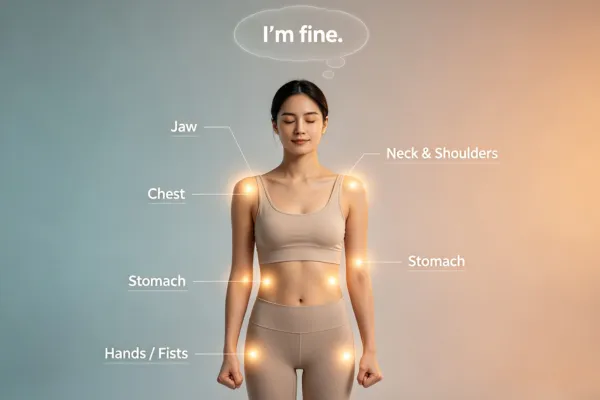
You've had those days. The ones where nothing catastrophic happened, but by evening you're exhausted, your neck is stiff, your chest feels tight, and your jaw aches. You don't feel stressed — not exactly. But your body clearly got the memo that your mind missed.
Here's what's worth understanding: your body and mind are not separate systems running parallel tracks. They are one integrated system, constantly in conversation. When emotional stress doesn't get processed, it doesn't just evaporate. It lands somewhere physical. And if you only look for stress in your thoughts, you'll miss half the picture — and half the path to relief.
This post walks you through five common ways the body quietly carries unprocessed stress, how to recognize each one, and what you can do about it. You'll also find a simple body-scan technique and a short daily practice to help you reconnect with your body's signals before they turn into something louder.
The Mind-Body Connection: Why Your Body Keeps Score
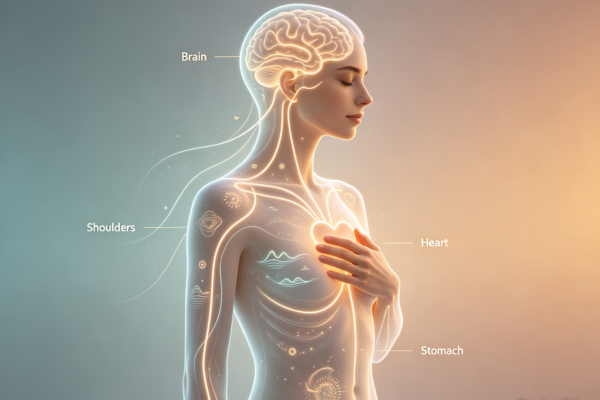
Most of us were taught to think of the body and mind as separate — the brain handles thoughts and feelings, the body handles the physical world. But that division was never accurate.
Your nervous system runs through your entire body. When you experience stress, fear, or emotional tension, your body responds immediately — muscles tighten, breathing shallows, digestion slows, and your heart rate shifts. This is the stress response doing its job: preparing you to face a threat.
The problem is that modern stress rarely involves a threat you can outrun or fight off. It's a difficult conversation, a pile of unfinished work, a relationship that feels off, a fear you haven't named yet. The stress response fires anyway — but without a physical outlet, the tension doesn't fully discharge. Over time, it settles into patterns in the body. And because it arrives gradually, most people stop noticing it. It starts to feel normal.
Bottom line: Your body is not separate from your emotional life. It's a record of it.
5 Ways Stress Hides in the Body
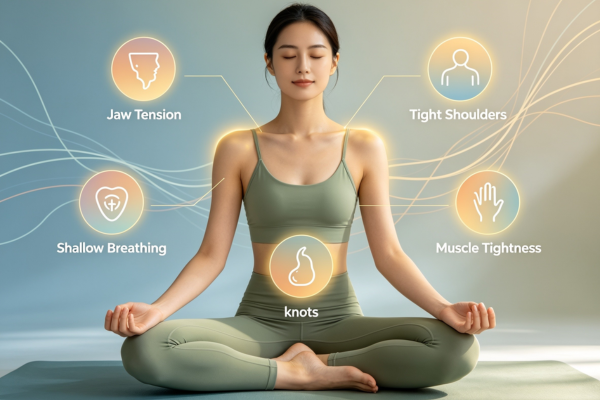
1. Tight Shoulders and a Braced Neck
This is perhaps the most common physical stress pattern, and the most overlooked. When we feel threatened — emotionally or physically — the shoulders instinctively rise and the neck braces. It's a protective reflex, a subtle form of guarding.
For many people carrying chronic stress, the shoulders never fully drop. They live in a state of low-grade elevation, sometimes accompanied by tension headaches, jaw tightness, or a stiff upper back.
Take a moment right now and notice where your shoulders are. Are they sitting relaxed, away from your ears? Or are they creeping upward? Most people are surprised to find them halfway up when they're just reading.
This pattern is often tied to feeling responsible for too much, carrying worries about what others think, or bracing against anticipated criticism or conflict.
Release tip: Slowly raise your shoulders to your ears, hold for five seconds, and then let them drop completely. Take a slow breath as they fall. Repeat three times. It sounds simple, but it interrupts the holding pattern and signals the nervous system that the threat has passed.
2. Shallow Breathing and a Tight Chest
When stress is present, breathing tends to become short and high in the chest — quick sips of air rather than full, nourishing breaths. This pattern is so common in people who carry chronic anxiety or overwhelm that many don't recognize they're doing it.
Shallow breathing keeps your nervous system in a mild state of alert. It's a feedback loop: the stress triggers the breathing change, and the shallow breathing maintains the stress signal. The nervous system reads "shallow, fast breathing" and concludes: something is wrong.
Meet Daniel — a project manager who came to realize he'd been holding his breath during stressful calls and shallow breathing for most of his workday. He didn't feel anxious, exactly. But he was exhausted, irritable by late afternoon, and couldn't wind down in the evenings. When he began paying attention to his breathing at regular intervals, and consciously deepening it, his mood and energy shifted noticeably within a week.
Release tip: Place one hand on your belly. Breathe in slowly through your nose for a count of four, allowing your belly to expand. Hold for a count of two. Breathe out through your mouth for a count of six. The longer exhale activates the parasympathetic nervous system — the part responsible for calm and recovery.
3. Digestive Discomfort and Gut Tension
The digestive system has its own extensive nervous system, sometimes called the "second brain." It's sensitive to emotional states in a direct, measurable way. Stress triggers physical changes in digestion — slowing it down, creating cramping, bloating, nausea, or loose stools in response to anxiety.
If you've ever felt "butterflies" before a presentation, or a knotted stomach during conflict, you've experienced this directly. For people under sustained stress, these sensations can become chronic — and are often treated as purely physical problems without addressing the emotional layer.
Common signs include an unsettled stomach before social situations, digestive discomfort that worsens during difficult life periods, or a persistent sense of tightness in the belly even when nothing is obviously wrong.
Release tip: Place both hands gently over your lower abdomen. Take three slow breaths directed down into that area. As you exhale, consciously soften the muscles beneath your hands. This simple practice helps you reconnect with and release tension held in the gut — tension that may have been there for hours without your awareness.
4. Facial Tension and Jaw Clenching
Stress lives in the face in ways most people never notice until the discomfort becomes obvious. The jaw is a particularly common site of unconscious tension — clenched during the day while concentrating, or ground at night while sleeping.
The muscles around the temples, the forehead, and even behind the eyes can carry persistent tension linked to mental effort, emotional suppression, or unprocessed frustration. Some people develop chronic headaches, sore jaw muscles, or dental problems before they ever connect these symptoms to stress.
A helpful self-check: Are your upper and lower teeth lightly touching right now? They should be gently separated, with the jaw relaxed. If they're clamped together, you may have been holding tension there for some time.
Release tip: Let your mouth fall slightly open. Move your jaw gently side to side. Take a breath and as you exhale, imagine the muscles around your jaw, cheeks, and forehead softening and releasing. This is especially useful after long periods of focused concentration or emotionally loaded conversations.
5. Restless Legs, Heavy Limbs, or an Urge to Move
Stress often creates what might be described as nervous energy looking for an exit. For some people, this shows up as restless legs at night, a persistent fidgeting urge, or a feeling of being physically "wired" even when mentally exhausted. For others, the opposite occurs — limbs feel heavy, movement feels effortful, and the body seems to be dragging.
Both patterns can reflect unresolved emotional tension. When the stress response prepares your body for action and that action never comes, the energy stays in the system. Over time it either continues seeking release through movement and restlessness, or it shifts into a kind of shutdown — a heaviness that is the body's version of emotional overload.
Release tip: Don't fight the urge to move. A brisk 10-minute walk, a few minutes of shaking out the limbs, or even brief jumping in place can discharge accumulated tension from the nervous system far more efficiently than sitting still and trying to think your way through it.
A Simple Body-Scan Technique
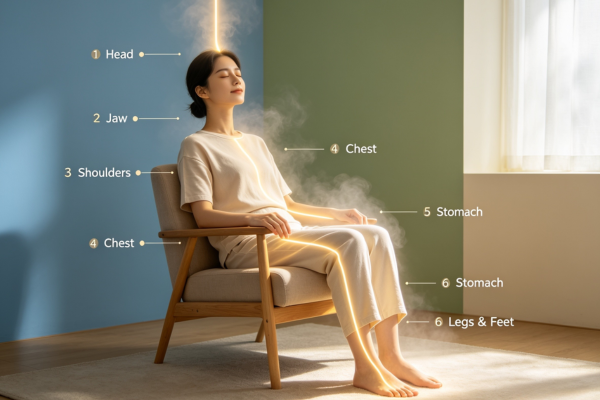
A body scan is one of the most direct tools you have for noticing where you're holding stress — and beginning to release it. It takes about five minutes and can be done anywhere.
Follow these steps:
Sit or lie down in a comfortable position. Close your eyes if you can, or soften your gaze downward.
Take three slow, deep breaths, each with a long exhale.
Starting at the top of your head, slowly move your attention downward through your body. Spend a few seconds at each area: scalp, forehead, eyes, jaw, neck, shoulders, chest, arms, hands, belly, lower back, hips, thighs, knees, calves, and feet.
At each area, notice without judgment. Is there tension? Tightness? Heaviness? A sense of numbness or disconnection?
When you find tension, breathe into that area on the inhale and imagine it softening slightly on the exhale. You don't need to force it to release — just notice and breathe.
Finish with three more slow breaths and take a moment before returning to activity.
You're not trying to fix everything in one session. You're developing the habit of listening to what your body is already telling you.
Why Physical Signals Are a Faster Path to Emotional Relief
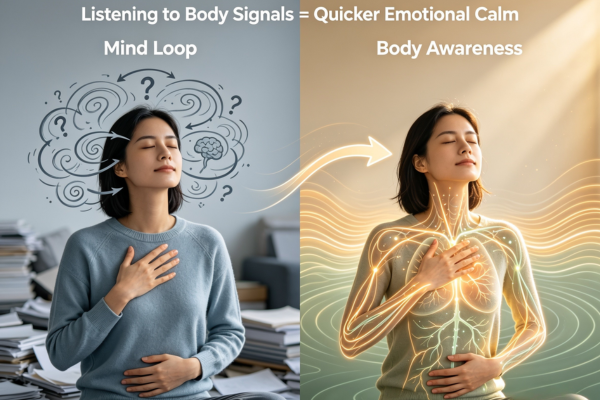
Here's something counterintuitive: addressing the body first often brings emotional relief more quickly than analyzing the emotion itself.
This is because your nervous system responds to physical signals in real time. When you soften your jaw, drop your shoulders, and slow your breathing, your nervous system interprets these physical changes as a signal of safety. That signal reduces cortisol, calms the stress response, and creates conditions where the emotional content can begin to settle.
Trying to reason your way out of anxiety while your body is still in alert mode is like trying to have a calm conversation in a room with an alarm going off. Attending to the body first quiets the alarm. From that quieter place, the emotional work becomes far more accessible.
This is why physical awareness isn't a side strategy for mental health — it's a central one.
Your Short Daily Body-Awareness Practice
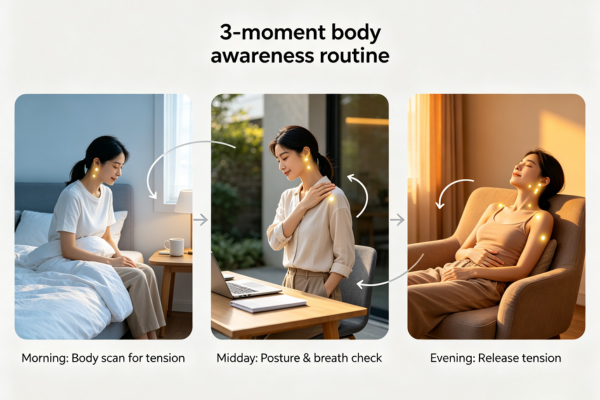
You don't need a lengthy routine. Five minutes, done consistently, creates real change over time.
Try this structure once each day — ideally mid-morning or during an afternoon break:
30 seconds: Three deep belly breaths before you do anything else
2 minutes: A quick body scan (head to feet) to notice and name where you're holding tension
1 minute: Targeted release — shoulders, jaw, or wherever you found the most tension
1 minute: Gentle movement — stretch, roll your neck slowly, shake out your hands
30 seconds: One slow exhale and a moment of acknowledgment: I checked in with myself today
That last step matters more than it sounds. Choosing to notice your body — in a culture that trains us to push through, override, and ignore physical signals — is an act of genuine self-respect.
Your Body Has Been Trying to Reach You
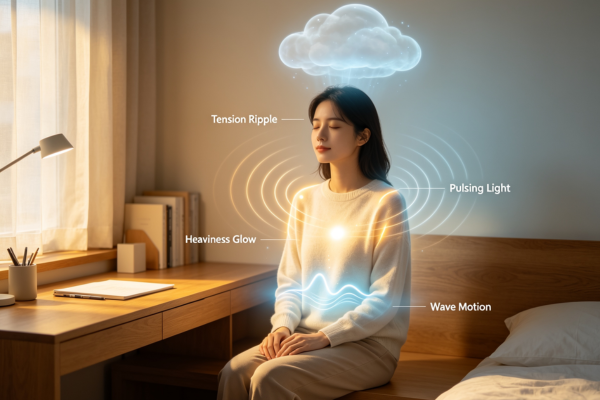
Stress that doesn't get acknowledged doesn't disappear. It waits. It tightens the shoulders, shortens the breath, knots the stomach, and braces the jaw until eventually it gets loud enough that you can't ignore it anymore.
But it doesn't have to get that far. When you learn to read your body's quieter signals — and respond with care rather than pushing through — you interrupt the accumulation before it peaks. You give your nervous system a chance to reset. And you build, over time, a more honest and responsive relationship with the most immediate information source you have.
Your body has been trying to reach you. Start listening, and you may be surprised at how much it has to say — and how much better you feel when you do.
